Jump to a question in this guide
- What does a sewage ejector do for a basement bathroom?
- How is sewage pumping different from a groundwater sump?
- Why does the wastewater need lifting instead of just a bigger drain?
- Can I follow one complete journey from the toilet to the sewer?
- What do the pump and float each do?
- Why does the level rise, fall and sometimes lead to repeated starts?
- Where does the discharge pipe take the wastewater?
- Why are there a sealed cover and a separate vent connection?
- Is the pump’s check valve the same as a sewer backwater valve?
- What happens during a power loss, and what does an alarm tell me?
- How should I describe noise, odour or a slow drain without guessing?
- Which records and checks actually answer the important questions?
- What should a service visit cover while the basin stays closed for me?
- How do I compare a repair, a replacement and a bathroom project?
- Which parts of the explanation are Canadian, local or model specific?
- How would a fictional buyer turn a pump label into a useful handover?
- A sewage ejector lifts connected-fixture wastewater; a groundwater sump serves a different collection route.
- Pump, level control, discharge, vent, cover, valves, power and alarm each have a distinct job.
- Match records and qualified findings to the actual equipment and route; keep a sealed basin closed for homeowner observation.
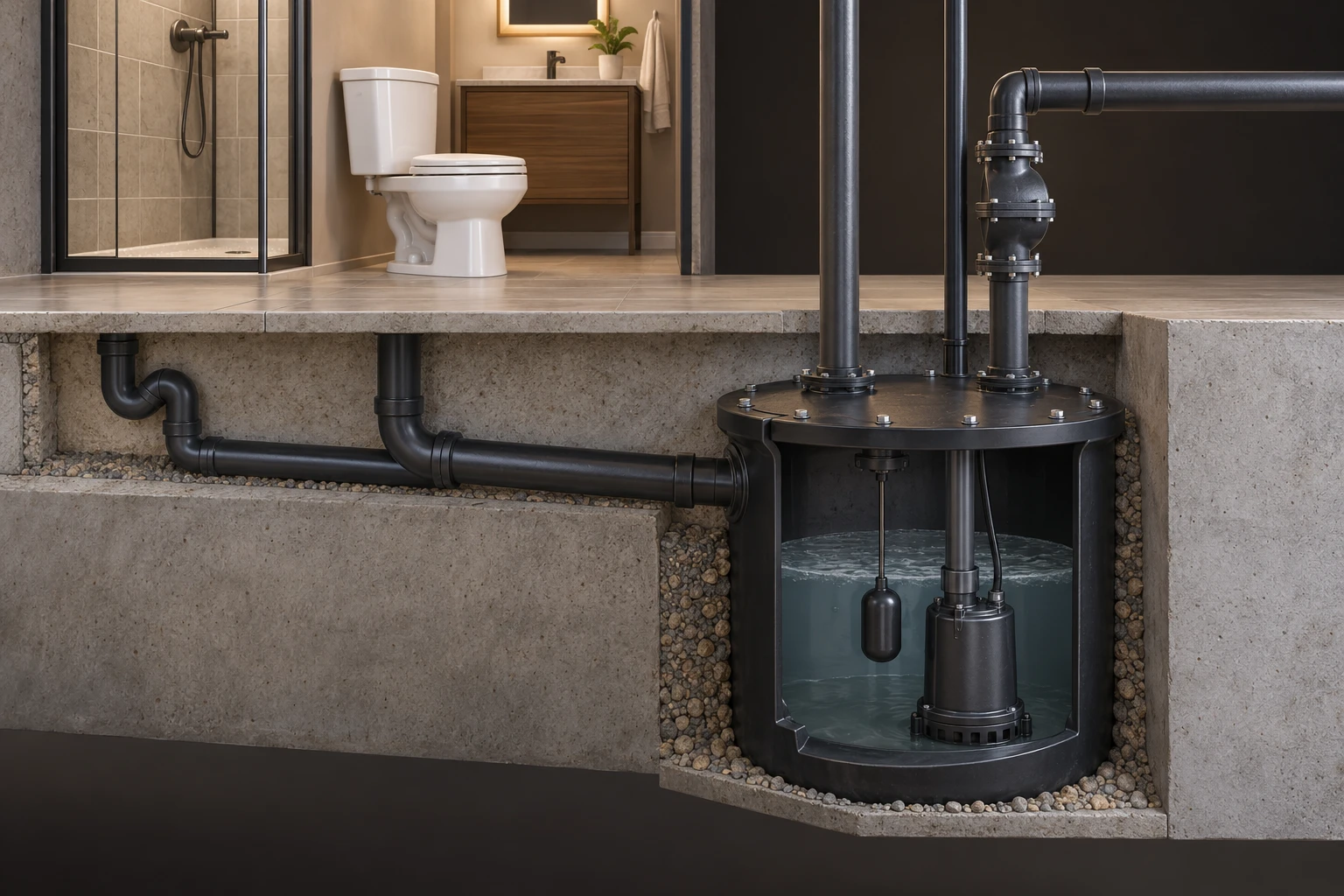
The basement fixtures drain toward a basin below the floor. The pump then supplies the lift to the higher drainage connection. These are two connected jobs: gravity brings wastewater down, and powered pumping moves it up. Start with the actual fixture connections and follow the discharge beyond this closer house section.
About this illustration
A conceptual layout with covered parts exposed. The far receiving destination, full vent route, wiring, sizes, support and actual control are outside this picture. Small incidental lines do not establish another connection. This is a conceptual teaching model, not an assessment of your home.
9 picture lessons appear beside the questions in this guide. Use them to understand the explanation, then consider what it means for your home.
What does a sewage ejector do for a basement bathroom?
A sewage ejector moves used water from low plumbing fixtures to a drain route they cannot reach by gravity alone. A toilet, shower or sink may empty through its branch into a covered collection basin below the floor. A pump then lifts that wastewater through a discharge pipe to the identified sanitary drainage connection. From there, the receiving system takes over.
The basin is the collection container. The pump provides the push. A level control tells the pump when to run, and the discharge pipe carries the pumped water onward. A vent serves the air space above the wastewater. These parts do connected jobs, but a pipe rising from a lid cannot by itself tell you which job it performs.
Start with a familiar fixture and follow its route. Does this toilet drain to the basin? Which other fixtures share that connection? Where does the pumped discharge join the building drain? The answers matter during an outage or service visit because they identify which everyday uses depend on this particular pump. They also prevent a second, unrelated basement pump from being mistaken for backup.
A working ejector can make a lower bathroom practical, but it adds equipment and controls to the drainage journey. Gravity still carries wastewater through appropriate parts of the system; the pump bridges the portion that needs lifting. The presence of a pump does not mean the entire home is pumped, nor that every fixture can keep draining if that pump stops.
If wastewater is backing up now, stop unnecessary use of the affected fixtures and keep people and animals away from the contaminated area. Do not cross water to reach a plug, pump or electrical panel. Seek the local utility’s response guidance and qualified plumbing help from a safe location. In Calgary, the City directs sewage-backup reports to 311 for initial triage; other communities have their own contact arrangements.
This guide teaches how to understand an identified sewage-lift system and discuss its care. It does not tell you to open a basin, lift a float, interrupt power, operate valves or run fixtures to create a test. A sealed lid stays closed for homeowner observation. Actual connections, condition, permitted use and performance need the matching records and appropriate professional assessment.
Follow wastewater below the floor and back up
The basement fixtures drain toward a basin below the floor. The pump then supplies the lift to the higher drainage connection. These are two connected jobs: gravity brings wastewater down, and powered pumping moves it up. Start with the actual fixture connections and follow the discharge beyond this closer house section.
Numbers identify the parts explained below.
- Low fixtures
The connected bathroom supplies wastewater to its identified drainage route. Similar floor levels do not establish the route at a real home.
- Below-floor basin
The basin receives wastewater between cycles. Its lid normally stays closed; the cutaway is for learning.
- Rising discharge
The pump supplies the lift. Confirm the full downstream sanitary route through records and qualified assessment.
What does this illustration leave out?
A conceptual layout with covered parts exposed. The far receiving destination, full vent route, wiring, sizes, support and actual control are outside this picture. Small incidental lines do not establish another connection. This illustration explains an idea. It is not an installation guide.
Which fixtures enter this basin, and where does the complete pumped route join the property’s drainage?
Explore this with HomeAI ↗Opens an editable question. Nothing is sent until you choose to send it.How is sewage pumping different from a groundwater sump?
A sewage basin collects wastewater from the fixtures connected to it. A groundwater sump collects water from an identified foundation-drainage arrangement. Both can contain a pump and a level control, which makes their appearances easy to confuse. Their contents, receiving routes and intended uses are different. Name the incoming water before deciding what the equipment does.
In a common groundwater arrangement, foundation drains collect water near the footing and carry it toward a sump pit. The sump pump sends that collected water toward an appropriate receiving location. The federal sump lesson describes this foundation-water job. It is not a sewage-ejector instruction, and its outdoor-discharge or battery-backup examples do not approve equipment for toilet wastewater.
In a sewage arrangement, a fixture branch carries used water into the collection basin, and the ejector discharge joins an identified wastewater route. Calgary’s wastewater page distinguishes its sanitary collection and treatment network from its separate stormwater pipes. That local distinction makes a useful teaching example: a convenient nearby pipe or yard outlet is not automatically the right destination for sewage.
Keep separate entries if the home has both systems. One entry names the basement bathroom, its sewage basin and the sanitary connection. The other names foundation-water collection, its sump and the receiving route. Mark concealed or unresolved connections as unknown. Do not fill the gap by assuming that two lids, similar pump sounds or matching pipe colours mean the systems are connected.
The distinction also changes outage planning. A backup unit supplied for a groundwater sump may not be suitable for the identified sewage application, its controls or its discharge duty. Ask the provider to identify the actual compatible arrangement and its limits. The word pump on a box or backup on a quotation does not settle those application questions.
If a seller describes a basement as protected because it has two pumps, ask what each pumps and where each discharges. Two different primary jobs are not necessarily redundancy for one job. The useful outcome is a clear, dated route explanation, rather than a reassuring equipment count. Follow the established sump/backwater guide for groundwater readiness and the wider sewer guide for the buried sanitary route.
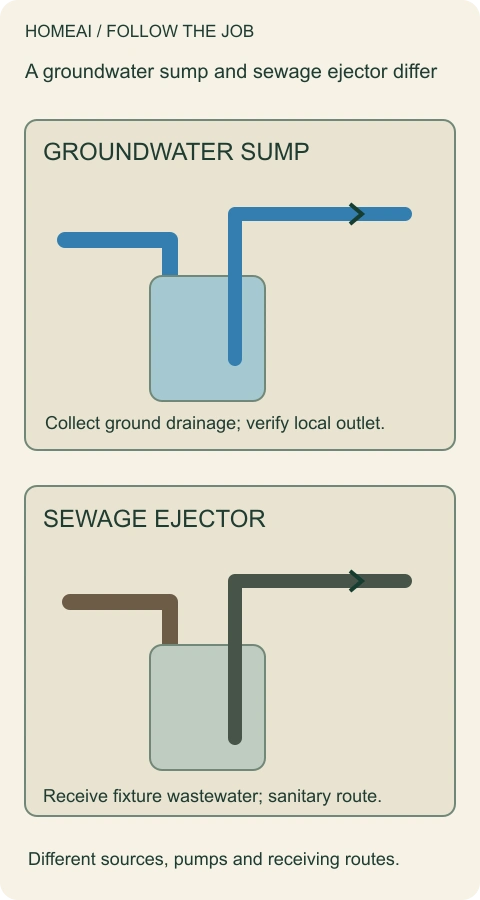
A groundwater sump and sewage ejector differ
The first route collects groundwater; the second receives fixture wastewater. The receiving arrangements and equipment need their own identification. One covered pit cannot be classified from a familiar lid alone.
Numbers identify the parts explained below.
- Ground drainage
The foundation drainage route serves groundwater and its locally permitted destination.
- Fixture wastewater
The sewage basin receives the identified fixture drains and pumps to an appropriate sanitary route.
- Actual identity
Use records and qualified assessment to establish which source and destination belong to this basin.
What does this illustration leave out?
Conceptual relationships only. No installed route, pipe size, control setting, tested performance or approval is supplied. This illustration explains an idea. It is not an installation guide.
Is this basin collecting ground drainage or receiving fixture wastewater?
Explore this with HomeAI ↗Opens an editable question. Nothing is sent until you choose to send it.Name the water before naming the pump
- Sewage ejectorCollects connected-fixture wastewater and pumps it toward its identified sanitary connection.
- Groundwater sumpCollects water from its identified foundation-drainage arrangement and sends it toward an appropriate receiving route.
- Two pumpsMay serve different primary jobs; an equipment count does not establish redundancy.
Conceptual job comparison; actual contents, connections, products and local permissions need identification.
Further reading: Pentair Hydromatic · Sewage Ejector Pump/Basin Package owner’s manual W-03-461; Government of Canada · Sump pumps; City of Calgary · Wastewater treatment system.
Why does the wastewater need lifting instead of just a bigger drain?
Gravity drainage depends on the relationship between the fixture route and the downstream receiving route. Wastewater must have a suitable path onward. A lower fixture may not have that gravity path to the available connection. Making a pipe wider does not lift wastewater uphill. The ejector supplies the energy for the required lift, after wastewater has reached its basin.
Think of two stages. First, wastewater travels from the connected fixture toward the basin. Second, the pump pushes it up and along the discharge route to the identified connection. Beyond that connection, the receiving drain has its own arrangement and condition. A pump can bridge an elevation difference; it cannot make an obstructed downstream sewer unlimited or establish that a concealed branch was built correctly.
Head is a term you may see in a pump discussion. It expresses the pumping demand in terms of fluid height. Elevation matters, and resistance through the actual route also matters. A professional matches the pump’s performance information to the installation’s duty. One horsepower number does not describe the resulting flow at every possible lift and pipe arrangement.
A catalogue’s maximum-flow figure and maximum-head figure are different limits, not a promise that both occur together in this home. Even a correctly identified model needs the route and application considered. Ask which operating condition supports a proposed selection and which retained piping or downstream condition was included. This lesson provides no pump-size calculation, pipe-size recipe or copied catalogue performance claim.
Changing a lower bathroom can change the question. A new fixture, altered branch, relocated basin or different discharge connection needs more than a replacement pump chosen by appearance. The professional must establish the relevant system and local requirements. Finishing the room or replacing the visible toilet does not demonstrate what is beneath the slab or how earlier concealed work was reviewed.
For a buyer, this becomes a records question rather than an automatic defect. Why is the pump there, what fixtures depend on it, and what documents describe the installed route? If those answers are missing, keep them as open questions for the appropriate assessment. The equipment’s presence alone does not establish a bad house, and a clean-looking basement does not establish a complete drainage design.
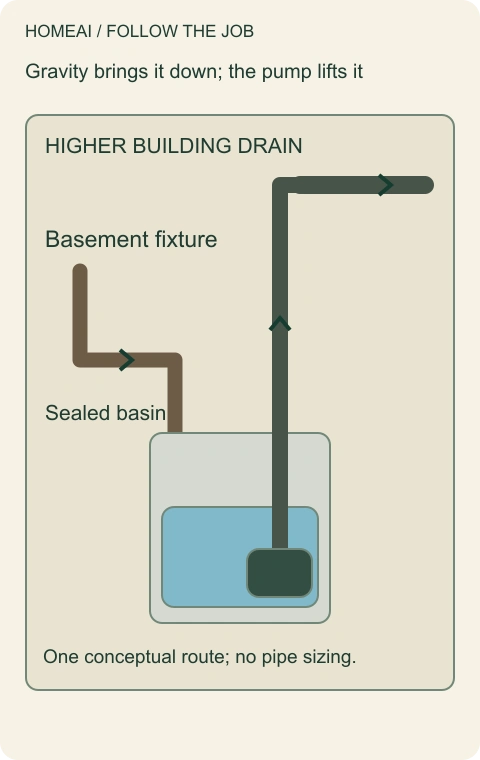
Gravity brings it down; the pump lifts it
The low fixture and higher drain explain why an ejector can be needed. Gravity moves wastewater toward the basin; powered pumping supplies the lift to the connected higher route.
Numbers identify the parts explained below.
- Fixture drainage
Identify the real fixtures and gravity route rather than infer them from room location.
- Pump lift
The pump adds energy; the complete rise and route influence the matched equipment question.
- Receiving route
Confirm the actual sanitary connection and downstream responsibility.
What does this illustration leave out?
Conceptual relationships only. No installed route, pipe size, control setting, tested performance or approval is supplied. This illustration explains an idea. It is not an installation guide.
Which change in level requires pumping in this home?
Explore this with HomeAI ↗Opens an editable question. Nothing is sent until you choose to send it.Can I follow one complete journey from the toilet to the sewer?
Begin when an ordinary connected fixture is used. Its wastewater enters the fixture’s drainage route and moves toward the collection basin. The incoming route and the pump discharge are different parts of that journey. A diagram can make the handoff visible even when the real branch is hidden beneath a finished floor. Hidden pipework still requires actual route evidence.
Inside the basin, incoming wastewater increases the collected volume and raises the level. The air space above it also changes. The level control responds according to its design, and the pump starts when the relevant control condition is reached. The teaching sequence separates these events so their causes are understandable; it does not supply an installed set point or a measured delay.
The running pump transfers energy to the wastewater and sends it into the discharge pipe. The discharge route lifts the flow toward its identified sanitary connection. A suitable check valve on the pump discharge helps limit reverse return through that pipe after pumping stops. Its job is local to that pumping route; the later valve chapter distinguishes it from broader sewer-backup protection.
If removal exceeds new inflow during the cycle, the collected level falls. The level control eventually reaches its stopping condition. A normal teaching cycle therefore includes both a rise and a fall, and both a start and a stop. Showing a pump only sending water upward would leave out why it runs intermittently and how it waits for the next incoming use.
The pumped wastewater does not become treated water when it leaves the basin. It continues into the receiving wastewater system. Calgary describes gravity pipes and pump stations carrying its wastewater toward treatment plants. A private sewage system has a different downstream context. Confirm the actual destination instead of extending a conceptual house drawing into an invented property or municipal finding.
Read the illustrated journey as a connected explanation, not a homeowner test. Its stages and playback duration are teaching choices, not real seconds, litres, capacity or reserve time. Keep the complete static stage notes available when motion is paused or unavailable. The practical question is whether the professional can identify each corresponding part in this home and state which connections or operating conditions remain unresolved.
From the basement fixture to the higher drain
Read eight connected steps, or play one 64-second lesson. The pace is for reading. It does not represent a pump’s real timing, capacity or settings.
- Wastewater in: connected fixture → gravity inlet → basin.
- Wastewater out: pump → check valve → higher sanitary drain.
- Air: basin air space → separate atmospheric vent route.
- Level: float and control start and stop the pump.
Paused at step 1 of 8.
A connected fixture sends wastewater downward
Wastewater from the connected basement fixture enters its drain. This first movement is by gravity. An actual system map must identify the fixtures and upstream branches; this lesson follows one imaginary connected fixture.
Useful question: Which fixtures actually connect to this basin?
The complete lesson stays here as you read
A connected fixture sends wastewater downward
Wastewater from the connected basement fixture enters its drain. This first movement is by gravity. An actual system map must identify the fixtures and upstream branches; this lesson follows one imaginary connected fixture.
Useful question: Which fixtures actually connect to this basin?
The inlet delivers wastewater into the basin
The inlet ends in the receiving basin below the floor. The covered basin holds wastewater between pumping cycles. This cutaway exposes the interior for learning; an owner does not need to open the lid to follow the explanation.
Useful question: What establishes the inlet route and basin identity?
The changing level also changes the air space
Incoming wastewater takes up space that previously held air. The basin vent serves that changing air space and continues to the actual atmospheric vent route. It has a different job from the wastewater outlet.
Useful question: Has the complete vent connection and receiving air route been assessed?
The rising float operates the level control
In this float-controlled example, the rising liquid moves the float. The control starts the pump at its operating condition. The drawing supplies no starting height or adjustment instruction; actual switches and sensors differ.
Useful question: Which matched level control and instructions belong to the installation?
The pump supplies energy for the upward lift
The powered pump moves wastewater into the discharge. Gravity alone could not carry it to this higher connection. This successful fictional cycle assumes available power, a functioning control and a suitable unobstructed route.
Useful question: What does the qualified service finding establish about the complete pumping system?
Wastewater reaches the higher building drain
Follow the separate rising discharge to its higher connection. Wastewater then continues along the identified sanitary drainage route. The route outside the diagram remains a property-specific question; this is not a surface-water outlet.
Useful question: Where does the full discharge join the actual sanitary route?
The falling level moves the control toward stop
When removal exceeds incoming flow, the basin level falls. The float follows the change until the control stops the pump. The basin still contains some liquid in the illustration; no universally correct residual level is implied.
Useful question: What explains a reported change in cycle length or frequency?
The pump stops and the system awaits more inflow
The discharge check valve helps limit wastewater returning down the pumped route. New fixture use can begin another cycle. An alarm, continuing rise, unusual operation or spill requires the actual failure-response plan; this normal lesson does not test protection.
Useful question: Who maintains the system, and what is the documented response to a fault?
If something is wrong: stop affected use, keep people away from contamination and wet electrical areas, and follow the qualified provider’s and local authority’s response instructions. Do not open the basin or reproduce the fault.
What do the pump and float each do?
The pump moves wastewater; the float helps control when that movement happens. In a float-controlled system, the float changes position with the liquid level and operates a switch. The pump’s motor drives its internal pumping parts. The control and the moving-water job are linked, but they are not the same component. A motor sound does not independently establish that the float responded correctly or that wastewater moved onward.
An impeller is the rotating part that transfers energy to the fluid in this type of pump. Its construction and the passage through the pump belong to the particular product. Sewage handling does not mean a unit can accept every object someone might flush. Do not assume that every sewage ejector grinds waste, or that a grinder, effluent pump and sump pump are interchangeable products.
The historical 218 package manual illustrates why control movement matters: it directs the installer to arrange the pump so its float can move freely. That is a mechanism lesson about a control needing its intended range. It is not an invitation to reach inside, move a float by hand or decide the correct adjustment for an unfamiliar installation.
Different products can use different float arrangements and controls. Pentair’s current 218 page mentions more than one float option, while the linked 2014 manual depicts one package arrangement. These source bodies should not be blended into a supposedly universal assembly. Identify the actual pump and control through records and the provider, then obtain the instructions that match them.
A control problem, pump problem and restricted discharge can all interfere with the intended cycle in different ways. The professional must distinguish them with an appropriate assessment. Replacing a pump without establishing why the system behaved differently may leave an unresolved control or route question. Conversely, a past switch replacement does not by itself prove that the whole pump needs replacement now.
For normal ownership, retain the model, the control identity and the maintenance contact where they can be found without disturbing the basin. Ask the service provider to explain the normal sequence and which change should prompt a call. Do not pull cords, bypass the switch, add objects, loosen a cover or use the illustration to open the motor. The manufacturer expressly warns about electrical contact and maintenance hazards.
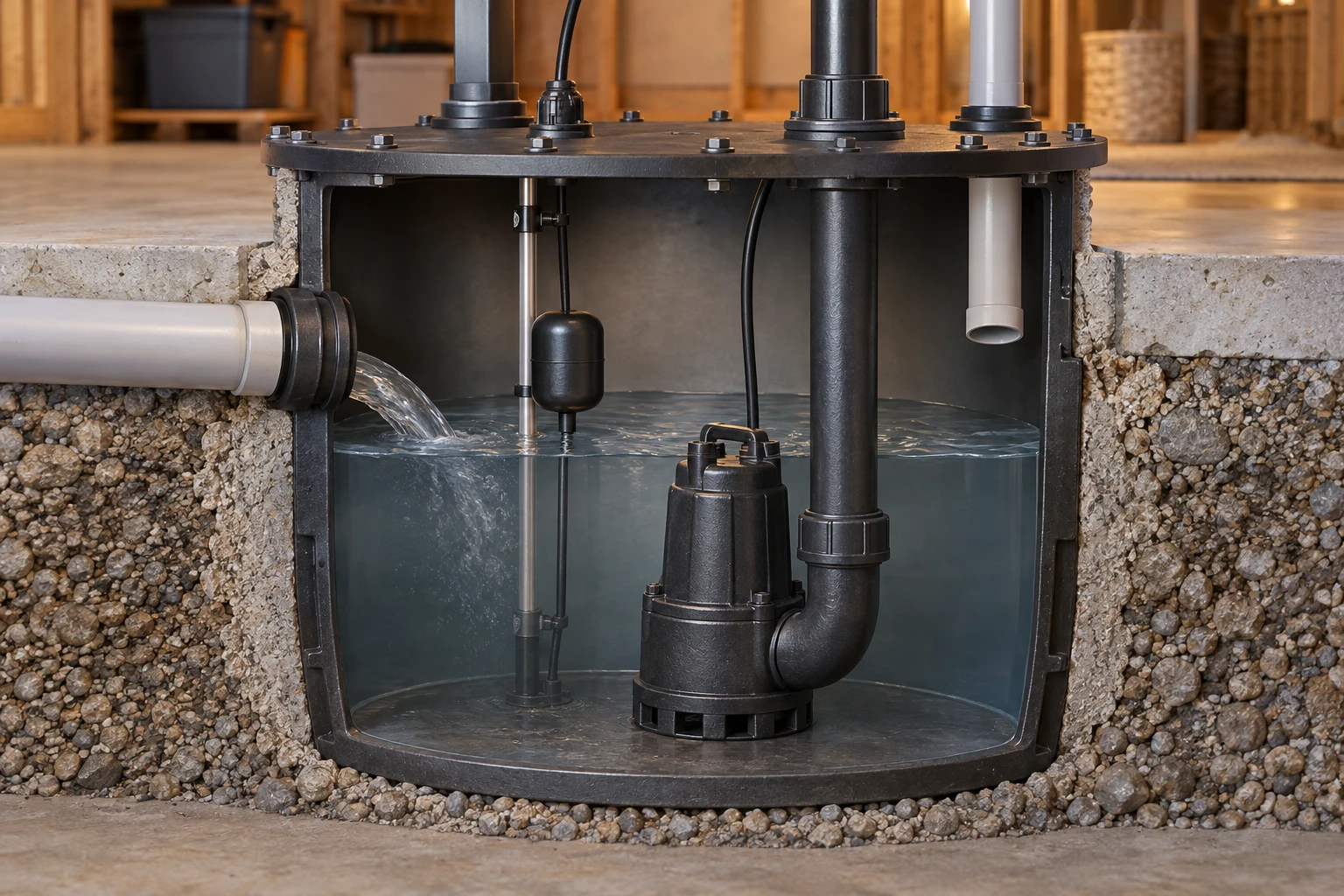
The float senses level; the pump moves wastewater
Wastewater arriving through the inlet raises the basin level. The float responds to that level and operates the control in this example. The pump has a different job: it moves wastewater into the discharge. A closer view helps separate the trigger from the equipment that supplies the lift.
Numbers identify the parts explained below.
- Inlet
Wastewater arrives from the identified connected fixtures. An inlet does not show every branch upstream.
- Level control
The guided float illustrates a rising-level trigger. Actual float and sensor arrangements differ by model.
- Pump and outlet
The pump moves wastewater into the separate rising pipe. A visible motor body or float does not prove operation.
What does this illustration leave out?
One conceptual float arrangement, with the cover and basin opened for illustration. Start/stop levels, clearances, unused incidental stubs, wiring and model-specific operation are not established. This illustration explains an idea. It is not an installation guide.
Which exact control is installed, and what does the qualified service record establish about a complete cycle?
Explore this with HomeAI ↗Opens an editable question. Nothing is sent until you choose to send it.Why does the level rise, fall and sometimes lead to repeated starts?
A collection basin receives intermittent fixture discharge. The level can rise while the pump is waiting, then fall during pumping if water leaves faster than it enters. The start and stop conditions create an operating cycle. The basin’s available collection volume and the control arrangement influence that cycle; they are not simply unused space around the motor.
This makes frequency meaningful only in context. A pump may run more during already-observed heavier use of its connected fixtures. That is different from starting again after no known new use. Record the ordinary context you noticed, including which fixtures were used and whether the behaviour changed. Do not repeatedly flush toilets or fill fixtures to create a comparison for this guide.
Repeated starts can have more than one explanation. New wastewater may still be entering from a connected fixture, discharge may return through a route that needs assessment, or the control arrangement may not behave as intended. These are investigation questions, not a diagnosis from sound alone. The provider should explain what evidence distinguishes incoming flow, return flow and a control issue.
A longer run also needs a complete explanation. It could reflect different inflow, a more difficult discharge condition or equipment that is not moving the expected flow. Listening cannot establish the level inside a sealed basin or measure the volume delivered downstream. Do not assume a running motor means successful emptying, and do not interrupt it as an experiment.
The useful service record describes conditions as well as observations. Which fixtures were included? What control response was assessed? What was known about the discharge route and receiving drain? A note saying cycles normally may be helpful, but ask what that meant during the particular visit. It is a bounded finding under stated conditions, not a prediction for every future demand or fault.
An animation can show a high starting level, a pumping period and a lower stopping level without providing actual dimensions or operating settings. The labels should make that conceptual status clear. Your home’s basin size, usable volume and control levels need matched product and installation information. No universal start frequency, run duration, emergency storage capacity or waiting time is calculated here.
The level control starts and stops a cycle
This fictional normal cycle collects wastewater, starts pumping as the control responds and stops at the lower operating condition. Reading the sequence explains why cycle changes can involve inflow, controls or delivery.
Numbers identify the parts explained below.
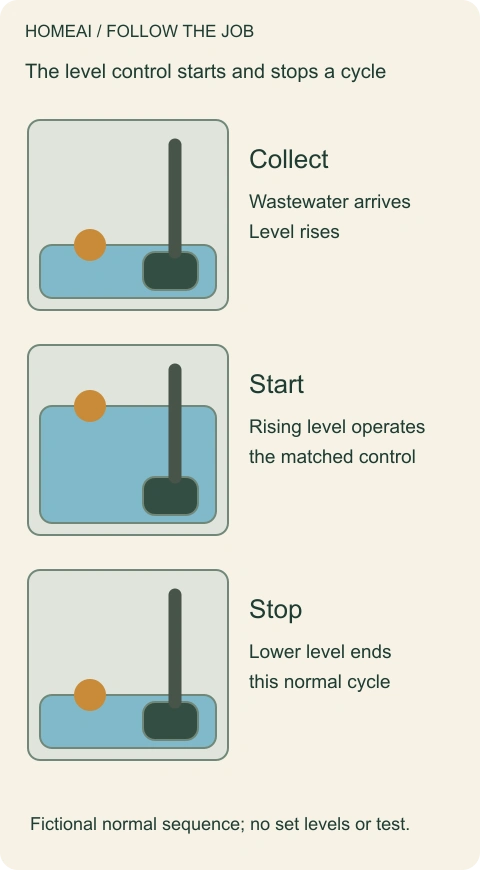
- Collect
Wastewater enters and the level rises between pumping cycles.
- Start
The matched control starts the pump; the actual type and operating conditions are model-specific.
- Stop
Removal exceeding inflow can lower the level to the stopping condition. The basin need not become completely dry.
What does this illustration leave out?
Conceptual relationships only. No installed route, pipe size, control setting, tested performance or approval is supplied. This illustration explains an idea. It is not an installation guide.
What changed about fixture use, level control or delivery when the cycle changed?
Explore this with HomeAI ↗Opens an editable question. Nothing is sent until you choose to send it.Where does the discharge pipe take the wastewater?
The discharge pipe receives pumped wastewater and carries it toward the identified sanitary connection. Follow the explanation beyond the vertical riser. The point where that riser bends out of sight is not the destination. Ask where it joins the building drainage system and which later route carries the wastewater off the property or into its private sewage arrangement.
The receiving connection matters because the pump is one part of a larger system. A clear-looking exposed pipe does not establish the condition of concealed discharge, the downstream building drain or the buried sewer. Likewise, a sewer camera report about a particular accessible drain route may not cover the ejector’s pressure discharge. Ask exactly which route the report actually examined.
A check valve may be visible on the discharge. Other fittings may provide service functions identified by the installer. Their presence is a reason to obtain the route and service explanation, not to turn handles or disconnect sections. A fitting’s shape or an arrow in a photograph cannot establish its internal condition, compatibility or installed direction without appropriate interpretation.
Keep the wastewater discharge distinct from a groundwater outlet. A pipe ending outdoors in a lawn scene can make sense for a particular groundwater teaching example; it cannot be borrowed as a sewage destination. Calgary’s separate wastewater and stormwater networks illustrate why the receiving system must be named. Local rules and the actual property arrangement determine the permissible connection.
For alterations, ask how the new work joins retained piping and how the provider will establish that the intended route is available. A quotation should name access work, retained sections and completion evidence. A pump invoice alone may not describe any of those. If the discharge becomes concealed after finishing, retain useful dated route photographs and drawings from the authorized work.
If backup or leakage occurs, avoid unnecessary wastewater use and get qualified help rather than trying to clear the discharge yourself. Do not open a coupling, force a valve, add chemicals or redirect the pipe. The proper investigation may concern the pump route, a fixture branch or the downstream sewer. Establishing the location of the problem is part of the professional scope.
The discharge reaches a higher building drain
The pump outlet rises from the basin and joins the higher drainage route. The valve body on that riser represents the discharge check-valve question: limiting return flow after pumping stops. Follow the route past this joint when asking where the wastewater ultimately goes.
Numbers identify the parts explained below.
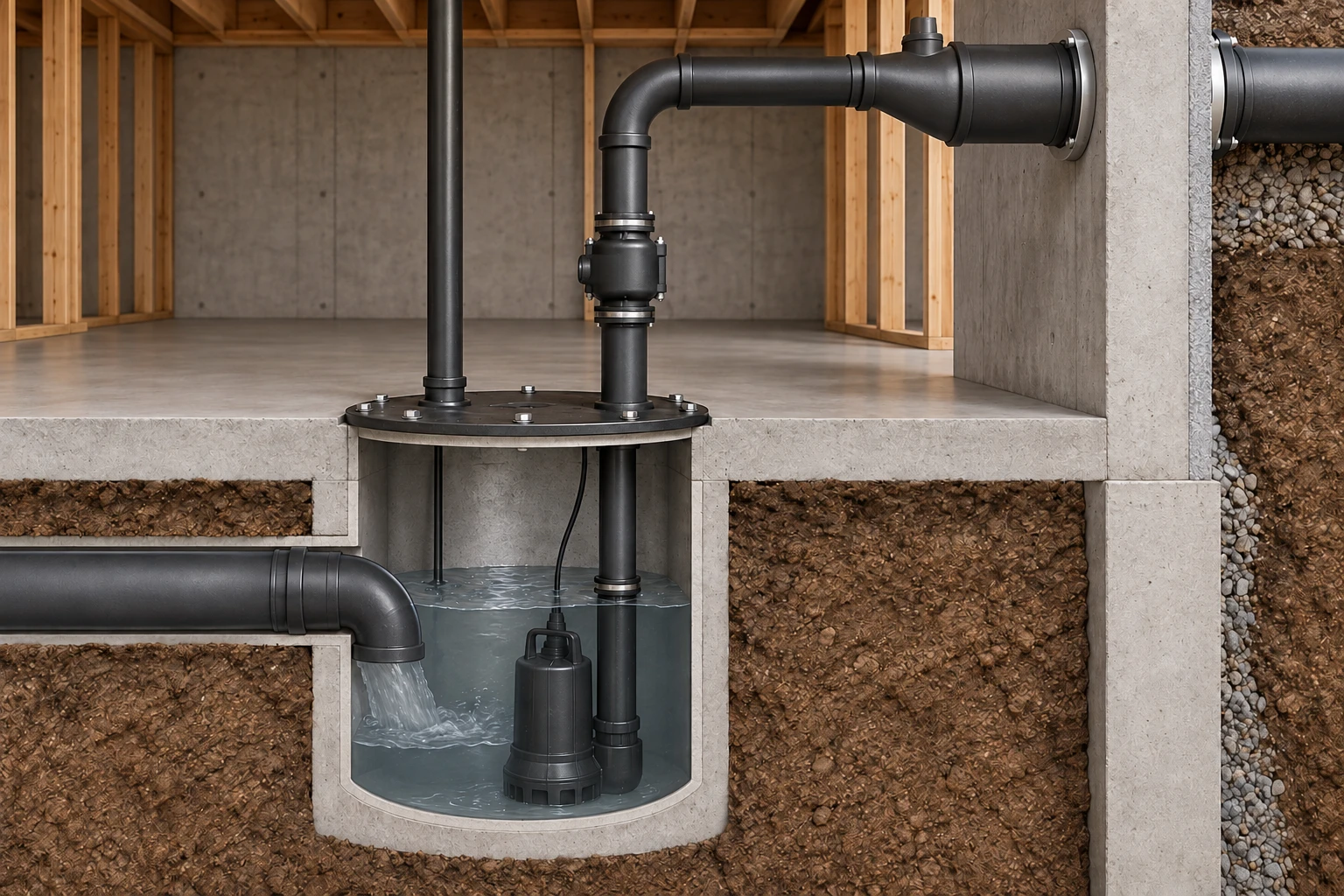
- Pump outlet
Pumping adds the energy needed for upward movement. Delivery depends on the complete identified system.
- Valve on the riser
Ask about the matched check valve and its assessed operation; its illustrated body is not a product identification.
- Higher drainage connection
The route continues beyond the scene. Obtain a useful description of the actual sanitary destination.
What does this illustration leave out?
The edited valve has no directional marking. The image establishes no tested valve action, exact fittings, pipe slopes, sizes, connection approval or receiving destination beyond the frame. This illustration explains an idea. It is not an installation guide.
Has the complete pump, valve and downstream route been assessed together?
Explore this with HomeAI ↗Opens an editable question. Nothing is sent until you choose to send it.Why are there a sealed cover and a separate vent connection?
The basin collects wastewater below a cover. The cover and its intended seals separate the collection space from the room. Where pipes and cords pass through that assembly, the particular system needs its specified sealing arrangement. The historical 218 manual names a cover gasket and sealed penetrations. A bolted-looking lid by itself cannot establish that all of those parts are present or sound.
The basin also contains air above the liquid. Incoming wastewater reduces that air space, while pumping out wastewater increases it. Venting serves the air connection as those conditions change. This is a different job from the discharge pipe carrying liquid onward. In a complete teaching diagram, the vent attaches to the air space and remains distinct from the pumped-liquid route.
The manufacturer requires its sewage-handling system to be vented in accordance with local plumbing codes. That requirement does not supply the design for every house or identify an unfamiliar pipe from its colour. Ask the plumber to explain the actual vent route, how it connects to the relevant system and what instructions and local requirements apply to this installation.
Do not replace that investigation with a generic valve or roof-pipe assumption. This guide does not approve an air-admittance device, claim that any visible vertical pipe is an adequate vent, or specify an acceptable termination. Different plumbing arrangements require appropriate review. A drawn line continuing upward means only the labelled conceptual route unless the actual destination has been independently identified.
An odour near the equipment can prompt questions about the basin assembly, but other nearby drainage parts can also matter. An infrequently used fixture trap, a leaking drain or another source may need consideration. Odour alone cannot locate a leak or establish that an atmosphere is safe. Do not lift the cover to sniff, inspect the contents or search for the source.
Keep routine observation external: an already-visible damaged cover, reported odour, accessible label or dated service finding can be recorded from a safe location. Ask what the provider assessed about the cover, penetrations and vent, and what stayed concealed. The drawing may expose a basin to explain it; the real basin remains closed until an appropriate professional manages the hazards and service procedure.
Air and wastewater follow separate paths
As wastewater enters or leaves the basin, its liquid level and air space change. The vent serves that air space; the pump discharge carries wastewater. The diagram keeps those jobs visibly separate.
Numbers identify the parts explained below.
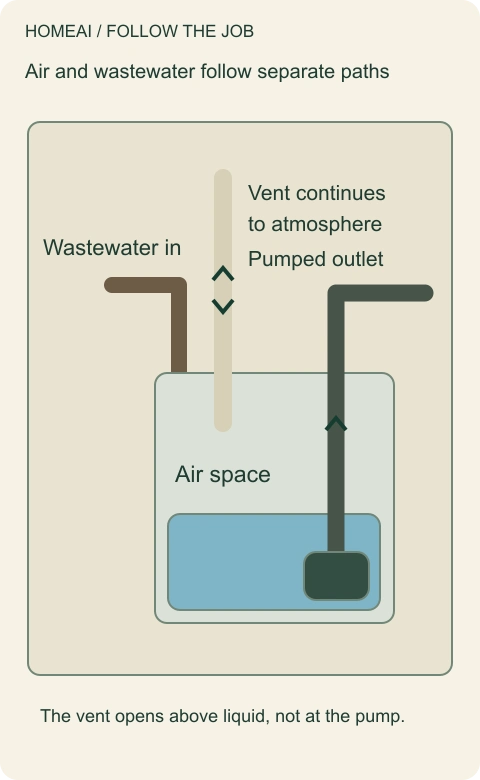
- Changing air space
Incoming wastewater takes up space; pumping leaves more air space.
- Atmospheric vent route
The drawn vent opens above liquid and continues to atmosphere. Have the actual full route assessed; this is not an installation drawing.
- Separate pumped discharge
The outlet begins at the pump and carries wastewater away. It is not the air-space connection.
What does this illustration leave out?
Conceptual relationships only. No installed route, pipe size, control setting, tested performance or approval is supplied. This illustration explains an idea. It is not an installation guide.
How does the actual sealed basin manage both wastewater movement and displaced air?
Explore this with HomeAI ↗Opens an editable question. Nothing is sent until you choose to send it.Is the pump’s check valve the same as a sewer backwater valve?
A discharge check valve helps limit liquid returning down the pump discharge after pumping stops. That return would bring some discharged wastewater back toward the basin. The check valve acts on the identified pumped route. Its function is therefore tied to the pump’s lift and cycle; it does not become a complete guarantee against every way a sewer can back up.
A backwater valve is installed on an identified wastewater drain route to limit reverse flow from the receiving system toward connected fixtures. The federal backwater page describes different valve types and placement considerations. Its location and protected branches matter. Do not assume that a check-valve-shaped fitting above an ejector provides the same protection or covers the whole building.
These devices can belong in the same home while answering different questions. For the ejector, ask what limits return in the discharge. For sewer-backup protection, ask which drains are on the protected side of the actual backwater arrangement. The plumber should describe how the complete installed system behaves, including what happens to new household discharge when a route is restricted.
A closed backwater route can also limit the household’s ability to send additional wastewater through it. That is why the real response instructions and connected fixtures need to be known. Do not force a valve open or assume an ejector can simply pump past any downstream condition. During an unexplained valve alarm or suspected backup, avoid unnecessary wastewater use and obtain the actual response guidance.
Maintenance and assessment depend on the identified product and safe access. A service invoice saying valve cleaned is incomplete without the valve identity and work scope. Was it the pump-discharge check valve, the sewer backwater valve or a different device? Ask what condition or function was assessed and which exclusions remain. Keep that answer with the appropriate route entry.
The native comparison should show two separate jobs rather than draw them as interchangeable parts. This lesson gives no owner valve-operation, opening or cleaning sequence. It supplies no claim that a valve is present because of the home’s age, no universal replacement interval and no flood probability. The useful result is understanding the actual protected route and the limits of each component.
Two valves answer different flow questions
A discharge check valve helps limit return down the pumped route after pumping stops. A backwater valve addresses reverse flow in its actual drainage location. Their roles and assessed scope remain separate.
Numbers identify the parts explained below.
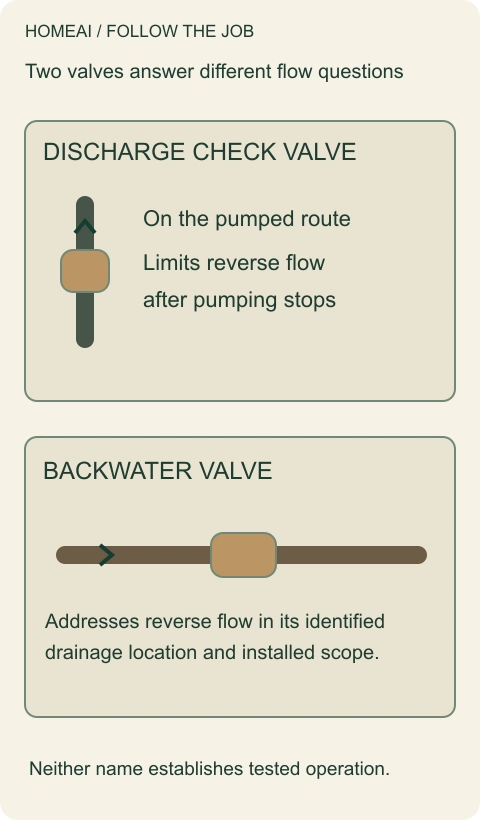
- Discharge check valve
Match the pump outlet, valve and service finding. Its presence does not prove operation.
- Backwater valve
Identify the actual protected location and limitations rather than assume every fixture is protected.
- Separate evidence
A record for one valve does not test the other. Ask what was examined and demonstrated.
What does this illustration leave out?
Conceptual relationships only. No installed route, pipe size, control setting, tested performance or approval is supplied. This illustration explains an idea. It is not an installation guide.
Which reverse-flow question is each actual valve intended to address?
Explore this with HomeAI ↗Opens an editable question. Nothing is sent until you choose to send it.Two one-way jobs need two route questions
- Pump-discharge check valveWhat limits wastewater returning down this pump discharge?
- Sewer backwater valveWhich drain branches lie on the protected side of the identified reverse-flow arrangement?
- Restricted receiving routeWhat must the household stop using, and what do the actual warning instructions say?
No interchangeable-valve claim, owner operation, universal placement or whole-home protection finding.
Further reading: Pentair Hydromatic · Sewage Ejector Pump/Basin Package owner’s manual W-03-461; Government of Canada · Backwater valves.
What happens during a power loss, and what does an alarm tell me?
An electrically driven sewage pump needs a functioning power supply and its intended controls to move wastewater. If that pumping function is unavailable, connected fixtures may still send wastewater into the basin. The collection space is finite. Do not assume the bathroom remains usable for a particular number of flushes or minutes; no reserve volume or safe-use allowance is established by this guide.
Ask the installer which fixtures depend on the pump and what the household should do if power is lost or the equipment reports a fault. Keep those instructions easy to find. A practical plan identifies the affected uses, the service contact and any compatible backup arrangement. It also addresses access hazards rather than sending someone through water to reach a plug or panel.
An alarm is a signal from its identified device. It might concern a liquid level, a controller, a power condition or another monitored event, depending on the installation. An alarm box on the wall does not tell you which condition it detects. Ask for the model, meaning of each relevant signal and the response instruction; do not infer those from a light colour.
A high-level warning, where fitted, warns about the condition it is designed and installed to detect. It does not pump wastewater away, locate the cause or prove that the receiving drain is clear. Conversely, no audible warning is not proof that every dependency is ready. Ask how the actual alarm and its own power or communication dependencies are assessed under the matching instructions.
A battery cabinet, generator or second pump needs an application-specific explanation. Groundwater backup advice cannot be transferred automatically to sewage equipment. The qualified providers must establish compatibility, what is powered, the control arrangement and how readiness is checked. Retain stated limits and unresolved conditions instead of converting a product label into an invented protection runtime.
Do not stage an outage, unplug equipment, bypass a control, silence an unexplained warning or improvise an extension-cord connection for this lesson. If water may contact electrical equipment, stay clear and contact the appropriate local utility or emergency service from a safe place. An outage plan is useful when it prevents unsafe experiments and identifies the correct help before a problem occurs.
How should I describe noise, odour or a slow drain without guessing?
Describe the observation before naming a failed part. A new sound after ordinary fixture use, an already-noticed change in run pattern or wastewater appearing at a particular drain gives a provider something concrete to investigate. Note the location, approximate time and ordinary use already observed. Do not run more water, open the basin or provoke the behaviour to make the report more complete.
A slow sink can concern the sink’s own trap or branch before wastewater reaches the basin. Several affected lower fixtures raise a different route question, but still do not identify a failed pump by themselves. A downstream restriction, control problem or another drainage issue may need assessment. Which fixtures share a route is often more useful than the phrase all the plumbing seems bad.
A pump sound confirms only that a sound occurred where you perceived it. It does not measure flow, show the liquid level or establish that the discharge is reaching the intended connection. A vibration or stopping sound may involve the pump, pipe support, valve action or surrounding construction. Ask what the professional found rather than selecting a replacement part from the sound description.
Odour needs the same discipline. A basin seal or vent question may be relevant, and a nearby fixture trap or another drain source may offer an alternative. The guide does not turn smell into a contamination measurement or gas-safety assessment. Keep away from an unsafe area and obtain appropriate help. Do not enter a pit, lift a sealed cover or use a flame, chemical or improvised air test.
If wastewater rises from a toilet, sink or floor drain, treat it as a backup concern and stop unnecessary wastewater use. Keep people and animals away, and follow the local utility and qualified response advice. Calgary’s 311 triage distinguishes possible City infrastructure issues from internal plumbing concerns; it does not promise the City will investigate every internal part or remove finished-room obstructions.
A useful provider explanation connects the symptom, the assessed location and the recommended work. If the first visit identifies a blocked fixture branch while excluding the buried sewer, keep both statements. If a pump fault is identified but the vent remains outside the scope, that remains a separate question. An explanation becomes deeper when it narrows alternatives with evidence, not when every observation becomes a diagnosis.
Which records and checks actually answer the important questions?
Start with the equipment and its route: pump and control identities, basin and alarm instructions, connected fixtures, drawings and alteration records. Then separate the useful jobs of those records. A drawing describes intended or recorded connections; a service report describes the provider’s stated findings and work at its date.
Read a repair invoice against the parts it names. “Pump replaced” may document the pump without assessing the retained cover, vent or discharge. “Bathroom renovated” may concern fixtures and finishes. Ask which parts were assessed or retained and give each unanswered item a next action. Missing detail does not itself establish a failure.
An operating check should identify the equipment, conditions, observed response and excluded parts. A control response and a pumping cycle are different observations. Keep that exact result; do not expand it into a promise about every future demand, outage or concealed receiving route.
A sewer-camera recording addresses the accessible pipe route within its stated coverage. Its start, end and access limits matter. It does not automatically assess pump internals, electrical controls, the closed basin, vent or every pressure-discharge section. Use the camera report for the pipe question it actually addresses, alongside the other providers’ records.
Keep permit and inspection documents with their project scope and date. If a relevant document is missing from the seller’s folder, seek the appropriate local record search or authority clarification. A missing copy and a missing approval are different questions.
A useful household file has five plain-language entries: what is installed, what was noticed, what was assessed, what was done and what is still open. Keep original reports alongside that summary. Home Plan can organize the entries and responsible contacts; qualified findings stay attached to their original authors and evidence.
Read what each record actually covers
- Component invoiceNames the work billed or completed at its stated extent.
- Operating assessmentDescribes identified equipment behaviour under the stated conditions and methods.
- Sewer camera reportDescribes its accessible route and visible coverage, with exclusions.
- Permit or inspection recordDescribes the relevant project process and recorded scope at its date.
A record remains valuable within its scope; none automatically supplies every concealed connection or future outcome.
Further reading: Pentair Hydromatic · Sewage Ejector Pump/Basin Package owner’s manual W-03-461; City of Calgary · Sewage backups; City of Calgary · Plumbing and gas permits.
What should a service visit cover while the basin stays closed for me?
Prepare information and safe access. Give the provider the location, known connected fixtures, changes already noticed and available records. Explain covered service points and past alterations. Keep clear of contaminated water, and leave basin lids, drain caps and finishes in place.
Ask the plumber or relevant pump-service specialist to name the plumbing scope: pump, controls, covered basin assembly, vent, discharge and receiving connection. The provider chooses the safe assessment and service method. A cutaway helps you discuss those parts; it does not make opening sewage equipment an owner task.
Electrical questions belong with the appropriately qualified electrical provider under local requirements. An operating motor or accessible cord does not establish circuit suitability. The historical equipment manual’s electrical warnings are retained as model context, not reproduced as a Canadian owner installation procedure.
Agree how obstructed access and reinstatement will be handled before work starts. A cabinet, floor finish or storage layout can cover equipment or a cleanout. Identify who authorizes the access work and what disruption is included; do not remove construction or conceal a service point on your own assumptions.
At handover, request the named findings, completed actions, check conditions and remaining tasks. Keep the service contact and alarm response accessible to everyone responsible for the home. In a shared building, first establish who owns the equipment, who can authorize access and which units depend on it; the responsible manager coordinates that work. This guide establishes no provider credential, local availability or booking.
Useful observations can start with the lid closed
Keep the basin closed while gathering the safely available identity, service history and reported changes. The outside pipe routes and closed control can help a professional identify what needs assessment. A green light has only the meaning assigned by the actual controller instructions; it does not certify a working pump or alarm.
Numbers identify the parts explained below.
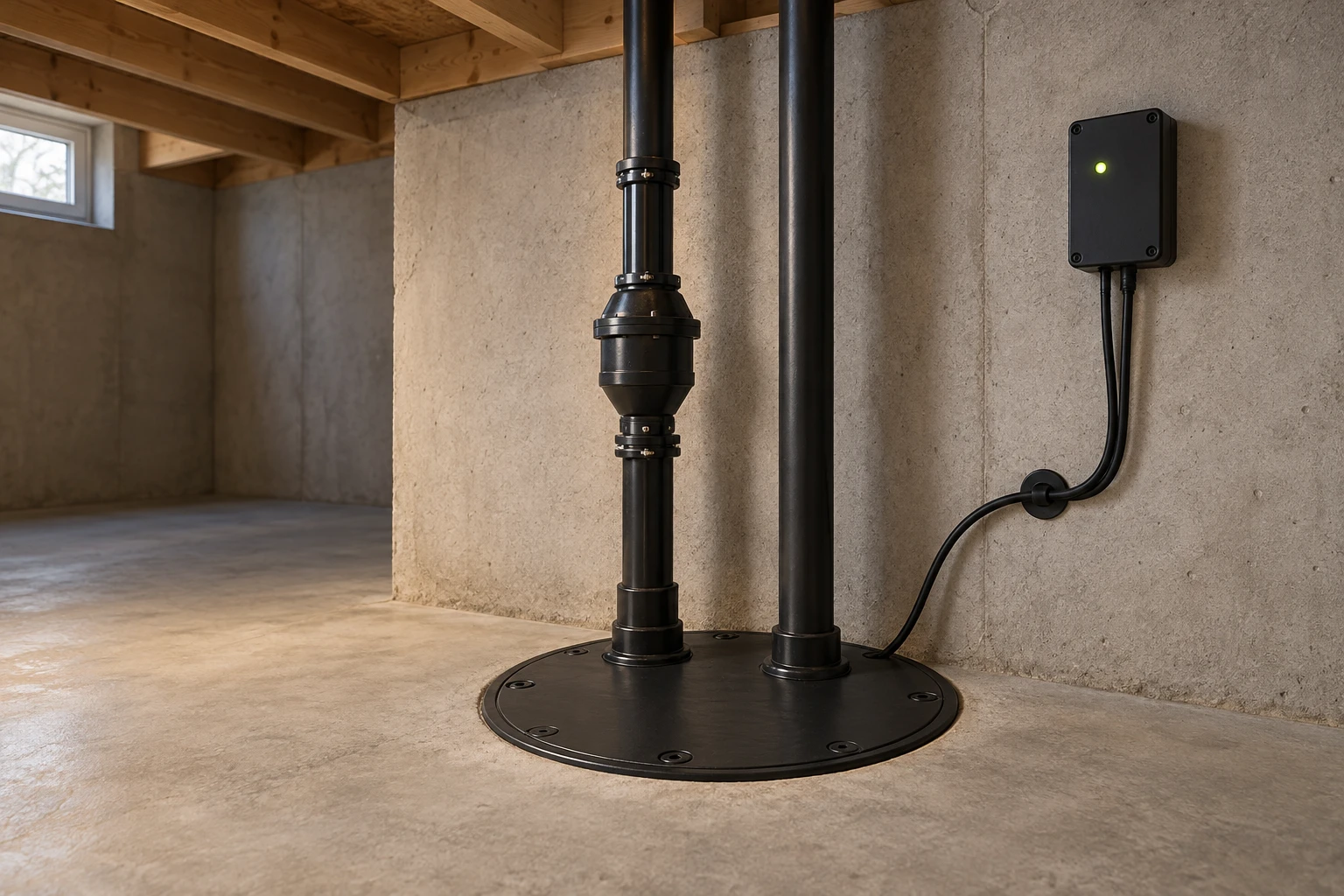
- Closed basin
The lid belongs with the contained wastewater system. Professional access and safe work procedures are separate from an owner’s record review.
- External routes
Record existing labels and information available from ordinary dry access. Let the provider resolve hidden connections.
- Closed controller
Match the exact model and instructions before interpreting a message. Report an alarm rather than reset or silence it to see what happens.
What does this illustration leave out?
No internal condition, electrical safety, alarm test, power availability or performance result is established. Do not open equipment, touch wet electrical areas or operate unfamiliar controls to reproduce a fault. This illustration explains an idea. It is not an installation guide.
What can be documented safely, and which checks require a qualified provider?
Explore this with HomeAI ↗Opens an editable question. Nothing is sent until you choose to send it.How do I compare a repair, a replacement and a bathroom project?
A repair addresses an identified problem within an established scope. A pump replacement changes a component or package. A bathroom project may change the incoming fixtures and concealed drainage as well as the visible room. Treat these as different proposals. The cheapest or newest-looking pump is not enough information to compare work that starts and ends at different places.
Ask each provider to connect the recommendation to its finding. Which part has been identified, what evidence supports the problem and why does the proposed work address it? If the cause remains uncertain, the next scope may be assessment rather than immediate replacement. If an emergency repair proceeds before every broader question can be resolved, retain that finite scope and the follow-up questions plainly.
For a replacement, identify the intended sewage duty, control arrangement, retained basin, cover and seals, vent, discharge connection, electrical requirements and any alarm. The provider decides which existing parts are suitable to retain and how that conclusion is established. A model with a similar name or larger motor does not automatically fit the original package or discharge duty.
For a bathroom alteration, ask whether proposed fixture changes affect the routes, pumping demand, access or local permit review. A room can be beautiful while its equipment remains hard to reach. Coordinate plumbing and electrical scope with the finish work so relevant access and completion records are not lost. Do not use this lesson as permission to cut a slab or connect a new fixture.
Compare the completion evidence as carefully as the product list. Which inspection or assessment is included, what will be documented, and how will unresolved concealed conditions be handled? Include access, restoration and authorized disposal or cleanup scope where relevant. This guide provides no national price, service-life promise or claim that a more expensive option gives whole-home protection.
For buying or selling, connect the proposal to the actual property decision. A dated repair invoice can be useful without resolving every future maintenance cost. A specialist finding may support a defined allowance or further investigation, but the market price decision has its own context. Keep construction, equipment, sewer and permit questions visible instead of turning a broad phrase such as fully updated into a technical conclusion.
Compare work that starts and ends in the same places
- RepairAddress the identified problem and state any wider unresolved questions.
- Equipment replacementMatch the actual sewage duty, controls and retained assembly rather than choosing by appearance.
- Bathroom alterationInclude incoming routes, access, equipment dependencies and local project review.
- Completion evidenceName the findings, checks, required process records and exclusions.
No price, sizing, life expectancy, equipment approval or property-specific work recommendation is calculated.
Further reading: Pentair Hydromatic · Sewage Ejector Pump/Basin Package owner’s manual W-03-461; Pentair Hydromatic · 218 sewage package basin system; City of Calgary · Plumbing and gas permits.
Which parts of the explanation are Canadian, local or model specific?
The basic lesson is about a physical job: collecting lower-fixture wastewater and moving it to its identified receiving drain. Product design, actual route and approval are different levels of detail. A general explanation of the job cannot decide which pump, control, vent or connection is acceptable for a particular Canadian property. Obtain the current instructions for the actual equipment and the relevant local review.
The linked Pentair manual is a four-page historical 218 package document bearing the printed date 03/12/14, with United States and Ontario contacts. It contains US electrical references and product-specific installation directions. This guide uses it to explain component jobs and hazards, not to establish current Canadian code, dimensions or a service procedure. Its date remains visible even though the current product page still links it.
The current 218 product page names a pump that differs from the model named in the historical manual diagram. That discrepancy is a useful reason to match documents rather than blend them. A current catalogue page, old installation record and actual installed model can describe different versions. Ask the manufacturer or qualified provider which instructions apply before relying on a detail.
Calgary’s wastewater network and311 response are named municipal examples. Calgary’s contractor-oriented permit page describes permits for installing, altering or adding plumbing. Those statements do not issue an approval, establish how another municipality handles replacement, or decide the requirements for a private sewage system. Confirm the actual work scope with the appropriate local authority and qualified provider.
Federal sump and backwater guidance helps distinguish groundwater pumping and reverse-flow protection. Its generic groundwater backup advice and owner-maintenance instructions are not transferred to sewage equipment here. Nor does a national educational page identify the connection in an older home. The source’s geography, date and purpose belong with the claim it actually supports.
Keep regional limits useful. Name the local contact, missing document and question that needs answering rather than reciting vague uncertainty. A rural private system, shared building or extensively altered basement may require a different specialist scope. This guide supplies no current code-adoption determination, equipment certification finding, actual inspection result or promise that any photographed arrangement is permitted.
How would a fictional buyer turn a pump label into a useful handover?
Fictional buyer Imani is considering a home with a lower bathroom, a closed round cover in a utility room and a second pump lid nearer the foundation. The seller calls both sump pumps and supplies an invoice saying basement pump replaced. There is no reported current backup. This invented file contains no actual inspection, confirmed defect, completed approval or purchase recommendation.
Imani first asks what water each basin receives. A fictional plumbing assessment is commissioned to identify the arrangements; its hypothetical report says the lower bathroom uses a sewage ejector while the other basin receives identified foundation drainage. The two entries now describe different jobs. Neither is called backup for the other, and no conclusion is drawn from the lids alone.
The old replacement invoice is then matched to its named equipment. Suppose it identifies the sewage pump and date but says nothing about the retained vent or downstream buried sewer. Imani keeps that useful component record and those exclusions. She does not rewrite it as all plumbing replaced or assume an excluded route is defective. Her next question is which missing answers matter to the decision.
The fictional provider explains the connected bathroom fixtures, the pump and float jobs, the accessible discharge and its identified connection. Any concealed section not established stays marked unknown on the route sketch. A separate sewer assessment is considered only if the purchase question requires that downstream information. A camera invoice is not substituted for the pump/control assessment.
The handover request also asks about the actual alarm, outage response, maintenance instructions and local project records. If the available file cannot establish a compatible backup arrangement, that remains an open planning item. Imani does not count a nearby battery box as proof of sewage-pump runtime or stage a power failure. The relevant provider explains the actual equipment rather than the buyer improvising a test.
Imani’s decision file now connects the lower bathroom’s use to its equipment, route, records and service needs. Her realtor can coordinate documents and the purchase discussion, while the plumbing and electrical professionals retain responsibility for their technical findings. A proposal for further work can be evaluated against its defined cause, extent and completion evidence instead of a general fear about every basement pump.
The learning outcome is a complete explanation: fixture wastewater enters the right collection basin, its level control starts the pump, the discharge carries it to the identified sanitary route, and the cycle stops as the level falls. Cover, vent, valves, power and alarm have their own jobs. The fictional handover supplies a better set of questions; it supplies no guarantee of a dry basement or approved installed system.
Keep learning about the connected parts
- Sump pumps and backwater valves: know each part’s job
- How home plumbing works: supply, drains, vents and pipe materials
- What a sewer scope can actually prove
- Home sewers explained: drains, buried pipes, roots and camera reports
- Build a home-care record that the next person can understand
- Before you make an offer: what to check, who to ask
- Before you list: explain repairs and upgrades clearly
- Home backup batteries: what stays on and for how long?
Canadian context and authorities · Visual atlas · Learning labs
Practice the distinction.
Two pump lids do not mean backup for one job
Fictional Imani has a lower bathroom, two closed pump lids and a component replacement invoice with limited scope.
Reported observations
- The seller uses one general name for two unidentified arrangements.
- The invoice names a pump change without covering every retained route.
- The actual alarm, outage response and document match still need clarification.
Compare the explanations
Expand each possibility to see the evidence needed to distinguish it. Similar symptoms can have different mechanisms.
The pumps serve different water
One may serve fixture wastewater while the other serves identified foundation drainage.
Qualified identification and a route sketch tied to the actual equipment.
A useful repair record has a limited extent
A pump invoice can document a real component change while vent, discharge or sewer questions remain open.
The original invoice, assessment scope and relevant follow-up records.
A useful next question
Obtain the installed-system explanation, exact equipment instructions and bounded professional findings before interpreting the home’s service needs.
Fictional only. No actual defect, successful test, pipe connection, inspection approval, backup runtime or purchase recommendation is supplied.
Know what the words mean.
- Sewage ejector
- A pumping arrangement that lifts collected wastewater from connected low fixtures toward its identified receiving drain.
- Collection basin
- The container receiving connected-fixture wastewater before the pump moves it onward.
- Float control
- A liquid-level-responsive control that operates a pump switch according to the identified system’s design.
- Impeller
- The rotating pump part that transfers energy to the fluid.
- Discharge pipe
- The route carrying wastewater away from the pump toward its identified connection.
- Head
- Pumping demand expressed as fluid height; actual elevation and route resistance matter to selection.
- Pump cycle
- A connected sequence of collection, level rise, pumping, level fall and control stopping.
- Basin vent
- The identified air connection serving the changing air space above collected wastewater.
- Discharge check valve
- A one-way device on the pump route that helps limit liquid returning down that discharge.
- Backwater valve
- A device on an identified wastewater drain route that helps limit reverse flow from its receiving system.
- High-level warning
- An alarm indication of the high-liquid condition its identified equipment is designed and installed to detect.
- Assessment scope
- The parts, routes, conditions and methods included in a provider’s stated investigation, with its exclusions.
Questions to bring
to the conversation.
- Which fixtures drain to this sewage basin, and which other basement pumps serve different water?
- Where does the discharge join the identified sanitary route?
- Which actual pump, controls, cover, vent, valves and alarm does the file describe?
- What is the real outage or warning response for the connected fixtures?
- What did each service, inspection or camera report cover and exclude?
- Who will assess unresolved plumbing, electrical, receiving-route and local-permit questions?
Separate a showing observation, an existing record and a new professional assessment. Unknown means a question remains; it does not automatically mean a defect.
Use the evidence planner ↗Go to the source.
Original HomeAI explanation informed by these public references. Sources support the underlying guidance; they have not reviewed or endorsed HomeAI. Diagrams are conceptual, and calculator outputs depend on your inputs.
Sources personally read October 13, 2026. Pentair’s four-page 218 package manual is W-03-461(03/12/14),©2014: a current product link to historical model-specific instructions, not current Canadian code. The current page names SKV40 while its linked manual diagram names BV40AV1; these identities are deliberately not blended. Calgary wastewater, sewage-backup and contractor-oriented permit pages are named local examples with no established substantive revision date. Federal sump/backwater pages show March 23, 2026. Their groundwater backup, age, interval, cost and owner-operation recipes are not adopted for sewage equipment. SK60 was not fully read and the old Liberty FAQ redirected to a different body, so neither supports a claim here. No installation dimensions, pump sizing, owner testing, opening, adjustment, wiring, valve operation, actual inspection, approval or HAUSE credential is supplied.
Publication & source review
First published .
Sources reviewed .
- Hydraulic Institute · Pump System Curves
Where this reference applies
Jurisdiction: General pump physics; no Canadian installation approval or sizing verdict
Edition: Page states last updated July 19, 2024.
Source reviewed: 2026-10-13 · America/Edmonton
Reading scope: Complete current substantive body/all 325 returned web lines independently read October 13, 2026; retained property/independent-ejector-head-primary.json. Other bounded HI returns are excluded.
Head as energy per unit liquid weight, static elevation/pressure and flow-dependent pipe/fitting resistance. Supports the conceptual route-demand explanation only; no formula, numeric worked example, installation measurement or owner test is adopted.
- Pentair Hydromatic · Sewage Ejector Pump/Basin Package owner’s manual W-03-461
Where this reference applies
Jurisdiction: Manufacturer document with United States and Ontario contacts; one historical 218 package example
Edition: ©2014; W-03-461(03/12/14), four pages. Current product page still links this historical manual.
Source reviewed: 2026-10-13 · America/Edmonton
Reading scope: All four pages/191 extracted web lines personally read October 13; full original body retained in root-research/ejector-full-1.json.
Pump, float movement, covered basin, gasket/penetrations, discharge check valve, sanitary destination and electrical/service hazards. No dimensions, wiring, owner testing, adjustment, repair procedure, warranty entitlement or Canadian code requirement adopted.
- Pentair Hydromatic · 218 sewage package basin system
Where this reference applies
Jurisdiction: Manufacturer product education; not a finding about an installed Canadian system
Edition: Undated substantive current product body, reached October 13, 2026.
Source reviewed: 2026-10-13 · America/Edmonton
Reading scope: Complete substantive current ordinary HTML/text captured and read in owner/ejector-product.*; current web also opened.
Separate package components, float choices and pump selection concepts. Current page names SKV40 while the2014 manual diagram names BV40AV1; these are not merged into one verified current configuration.
- City of Calgary · Wastewater treatment system
Where this reference applies
Jurisdiction: Calgary, Alberta; named municipal example
Edition: Undated substantive municipal page; retrieval date is not a publication date.
Source reviewed: 2026-10-13 · America/Edmonton
Reading scope: Complete substantive body personally read October 13 via fresh web and full retained root-research/ejector-full-2.json.
Household wastewater collection, gravity and pumping, treatment and separate stormwater network. Calgary receiving arrangements are not assigned to other Canadian communities.
- City of Calgary · Sewage backups
Where this reference applies
Jurisdiction: Calgary, Alberta; local response and service process
Edition: Undated substantive municipal page; no date inferred from footer.
Source reviewed: 2026-10-13 · America/Edmonton
Reading scope: Complete substantive body through prevention/backwater section personally read October 13 using fresh web plus retained full source body.
Contaminated-backup precautions,311 triage, plumber/City distinction, access and named service-report limits. No owner cleanout opening, sewer snaking or cleanup instructions transferred.
- City of Calgary · Plumbing and gas permits
Where this reference applies
Jurisdiction: Calgary, Alberta; contractor-oriented local permit page
Edition: Undated substantive municipal page; current reachable body October 13, 2026.
Source reviewed: 2026-10-13 · America/Edmonton
Reading scope: Complete substantive body personally read October 13 through full retained root-research/ejector-full-2.json and fresh web.
Local installation/alteration permit and inspection questions, technical-assistance route and private-sewage distinction. No permit approval or national rule inferred.
- Government of Canada · Sump pumps
Where this reference applies
Jurisdiction: Canada; national groundwater/flood education
Edition: Page details March 23, 2026.
Source reviewed: 2026-10-13 · America/Edmonton
Reading scope: Complete substantive web body personally read October 13, 2026.
Groundwater pit collection, float control, discharge, check-valve and power dependencies. Groundwater backup products, service intervals, testing procedures and siting numbers are not transferred to sewage equipment.
- Government of Canada · Backwater valves
Where this reference applies
Jurisdiction: Canada; national flood-readiness education with local/provincial requirements
Edition: Page details March 23, 2026.
Source reviewed: 2026-10-13 · America/Edmonton
Reading scope: Complete substantive web body personally read October 13, 2026.
Reverse-flow protection on identified wastewater routes, model/placement differences and professional/local review. No owner operation/cleaning recipe, cost estimate, installation age inference or universal interval adopted.
Have a question about your home?
Start with the symptom, timing and what you have observed.
Ask HomeAI