Jump to a question in this guide
- Why can hot water exist at the heater but take time to reach a tap?
- Where does water go when the tap stays closed?
- How can a system work without a dedicated return pipe?
- What do the pump, sensor and controller each contribute?
- Does circulation keep every branch equally ready?
- How should I describe a changed wait without testing the system?
- Could the explanation involve something other than the pump?
- How should water convenience and energy claims be compared?
- What needs to be in a professional proposal?
- Fictional example: does a new heater fix one distant bathroom?
- What should the final circulation handover make clear?
- The heater warms water; the pump moves it around an identified route.
- A dedicated return differs from a named cold-line crossover arrangement.
- Control state, fixture delivery and household energy need separate evidence.

The heater supplies warmth to the depicted loop. The upper tee has a short branch toward the closed tap, while a separate brown return descends through the circulator toward the heater. No water leaves the spout. This conceptual route omits complete supply, mixing and safety plumbing; colour identifies drawn teaching routes only.
About this illustration
No actual flow, temperature, pressure, fixture coverage, heater connection suitability or installation approval. The bathroom drain and complete cold supply are omitted. This is a conceptual teaching model, not an assessment of your home.
6 picture lessons appear beside the questions in this guide. Use them to understand the explanation, then consider what it means for your home.
Why can hot water exist at the heater but take time to reach a tap?
A water heater warms water. The hot-water pipe carries it toward a fixture. Those are separate jobs. Between uses, water already in a branch can cool. When the tap is used again, the water arriving first can therefore differ from the water available at the heater. Replacing a heater without understanding distribution can leave the original waiting question unanswered.
Hot-water recirculation gives water a route back toward the heating source rather than requiring every movement to end at an open tap. A small circulation pump moves water around that identified route. The heater supplies heat; the pump supplies movement; the controls decide when movement is requested. The tap still has its own ordinary delivery and temperature-control functions.
Start with your actual concern: a long first wait, water that becomes cool during use, one affected fixture, or the whole home. These descriptions help define an assessment without deciding the cause. A pump may be relevant to one distribution problem and irrelevant to a different heating, fixture or control problem. Neither a quick demonstration nor a missing pump is a diagnosis.
This guide owns the circulation journey and the decision about a proposed return route. The water-heater guide owns the equipment care file, while the apartment-water guide explains shared risers and management. The illustrations are separate conceptual examples. They supply no approved plumbing layout, universal delivery time or instruction to change a heater setting.
The return loop moves water while the tap stays closed
The heater supplies warmth to the depicted loop. The upper tee has a short branch toward the closed tap, while a separate brown return descends through the circulator toward the heater. No water leaves the spout. This conceptual route omits complete supply, mixing and safety plumbing; colour identifies drawn teaching routes only.
Numbers identify the parts explained below.
- Heater
Provides heat; its actual controls and safe installation need their own record.
- Supply
Carries water toward the served area in the conceptual loop.
- Closed tap branch
Branches from the tee; no water is drawn during this pictured state.
- Return and circulator
Complete the drawn circulation route back toward the heating source.
What does this illustration leave out?
No actual flow, temperature, pressure, fixture coverage, heater connection suitability or installation approval. The bathroom drain and complete cold supply are omitted. This illustration explains an idea. It is not an installation guide.
Which actual supply, closed fixture branch and return route did the provider identify?
Explore this with HomeAI ↗Opens an editable question. Nothing is sent until you choose to send it.Follow circulating water before the tap opens
Choose any stage or play the lesson. A complete pass from stage 1 lasts 64 seconds, with eight seconds per reading stage during playback. Paused and manually selected stages remain available as long as you need. These highlights are not physical cycle times, control settings, measured performance or a test result.
A conceptual dedicated-return loop with a temperature-feedback control example. Actual products can use different control modes, sensor locations and return arrangements. The matching Grundfos COMFORT10-16 English technical section and Taco SmartPlus English sheet supply named examples; this drawing is not either product's complete installation. No temperature, flow, operating duration, branch coverage or approval is established.
- Heater: Supplies heat to the identified hot-water arrangement; omitted mixing and safety components still need actual assessment.
- Supply and closed fixture branch: The supply passes the served area while a separate branch reaches the closed tap. Recirculation does not require water to discharge through that spout.
- Dedicated return and circulator: The return brings circulating water back toward the heating source. The pump provides movement around the circuit.
- Sensor and controller: Dashed lines carry information in this conceptual view; they are not water pipes or wiring instructions.
- Later ordinary draw: An open fixture draws water for use; that is a different state from closed-loop circulation.
Paused at stage 1 of 8.
Keyboard: use Tab to reach a control and Enter or Space to activate it. On a stage button, Left/Right selects the previous/next stage; Home/End selects the first/last stage.
The heater supplies warmth
The heater has the heating job. Follow its connection to the supply route without assuming the picture contains all actual temperature controls, valves or safety components. A heater identity and its care record remain separate from the circulation pump and the route served.
Useful question: Which heater and matching instructions identify the actual heating source?
All eight reading stages
The heater supplies warmth
The heater has the heating job. Follow its connection to the supply route without assuming the picture contains all actual temperature controls, valves or safety components. A heater identity and its care record remain separate from the circulation pump and the route served.
Useful question: Which heater and matching instructions identify the actual heating source?
Water can cool while waiting
Water already in a distribution pipe can cool between uses. The concern at a distant fixture therefore involves the route as well as the heating source. This view highlights the supply without supplying a cooling rate, temperature or predicted first-arrival wait.
Useful question: Which actual branch and ordinary-use concern are being assessed?
The documented control requests movement
In this temperature-feedback example, information from an identified sensor is used by the controller to request circulation. Other models and modes can behave differently. A dashed information route is separate from water movement, and an indicated control state does not measure every fixture's delivery.
Useful question: Which exact mode and sensor location belong to the installed product?
The pump moves water around the loop
The circulator provides movement through the identified circuit. It does not replace the heater's heating function. Its location and direction belong to the actual product and system; a conceptual arrow is not an installation or troubleshooting instruction.
Useful question: Which pump and complete route did the provider identify?
Supply passes a closed tap branch
Circulating water reaches the served loop while the fixture remains closed. The branch toward the tap is shown separately. No water leaves the spout during this stage, and the loop does not enter the wastewater drain. Any short fixture branch remains part of the delivery question.
Useful question: Which fixture branches are actually included in the circulation arrangement?
The dedicated return brings water back
A separate return completes this conceptual loop toward the heating source. Follow it all the way back rather than treating a nearby pipe as a proven return. Actual junctions, valves, branch balancing and temperature arrangements require their own identification and appropriate assessment.
Useful question: Where does the actual return begin and rejoin the heating arrangement?
Feedback can allow the pump to pause
The named temperature-control example can pause circulation according to its documented feedback. No fixed trigger or restart time is supplied here. A paused pump may reflect an intended state; an unexplained change still needs the appropriate product-specific assessment without owner resets or valve experiments.
Useful question: What stop and restart behaviour does the exact manual describe?
A later fixture draw is a different state
During ordinary fixture use, supplied water leaves through the open outlet for use. That is distinct from the earlier closed-loop circulation stages. The overall supply replenishment, delivered temperature and remaining branch wait need the actual system's records and findings; this lesson establishes none of those results.
Useful question: What fixture-delivery function was checked, under which conditions and with what limits?
Use the source notes in this guide to check the named examples, adopted scope and limits.
Where does water go when the tap stays closed?
In the dedicated-return concept, a supply route carries heated water toward the served area. A separate return pipe brings circulating water back toward the heating source. A branch connects to the fixture, but the closed fixture does not discharge water. The return joins the loop before the tap outlet; it is not a drain connection.
Following the complete loop matters more than spotting a small motor beside a tank. Ask where the supply leaves, which branch is served, where the return begins and where it returns. Concealed routes need drawings or qualified identification. A third visible pipe at a heater does not independently establish that it is the return, or which fixtures it reaches.
The native journey highlights the heater, supply, pump and return separately, then shows a later ordinary fixture draw. Its eight reading stages explain relationships rather than a literal control sequence shared by every installation. The tap remains closed during the circulation stages. Water flowing out of the spout belongs to the later draw, not to the return-loop lesson.
Actual systems include additional valves, temperature-control arrangements and other parts that these simplified views omit. An installer must assess them together. Do not trace pipes by touching hot surfaces, removing insulation, opening valves or following a route into an unsafe space. Request a provider’s annotated route account and keep the unanswered concealed portions clearly identified.
How can a system work without a dedicated return pipe?
A dedicated return is one arrangement, not the definition of every recirculation product. Grundfos Canada separately describes its ALPHA COMFORT SYSTEM example, where a named valve links hot and cold lines near a fixture so the cold line provides the return route under that product’s intended control. That is different from drawing a separate return pipe through the house.
Keep these concepts in separate frames. In the dedicated-return drawing, the return has its own route. In the named crossover concept, part of the cold distribution participates in the intended circulation arrangement. The latter needs a complete explanation of the actual valve, controls, fixture effects and compatible heater. A generic pump photograph cannot identify the arrangement.
A purposeful, documented product arrangement also differs from an unexplained cross-connection. Do not connect hot and cold lines or add a valve to imitate a diagram. The actual equipment and local plumbing requirements determine what is suitable. The cross-connection guide explains potable-water protection without declaring that every hot/cold connection is either approved or hazardous.
Ask the proposer to draw only the arrangement being offered and identify what changes in ordinary use. Which fixtures are included? What should the household expect at cold taps? What does the matching manual say about faults and service? A statement that no return pipe is needed should be followed by that explanation, rather than treated as evidence that no plumbing design work remains.
Two return concepts need separate explanations
A dedicated return brings circulating water back through its own pipe. The named crossover alternative uses the cold line under its intended valve and controls. Neither route discharges through the closed tap.
Numbers identify the parts explained below.
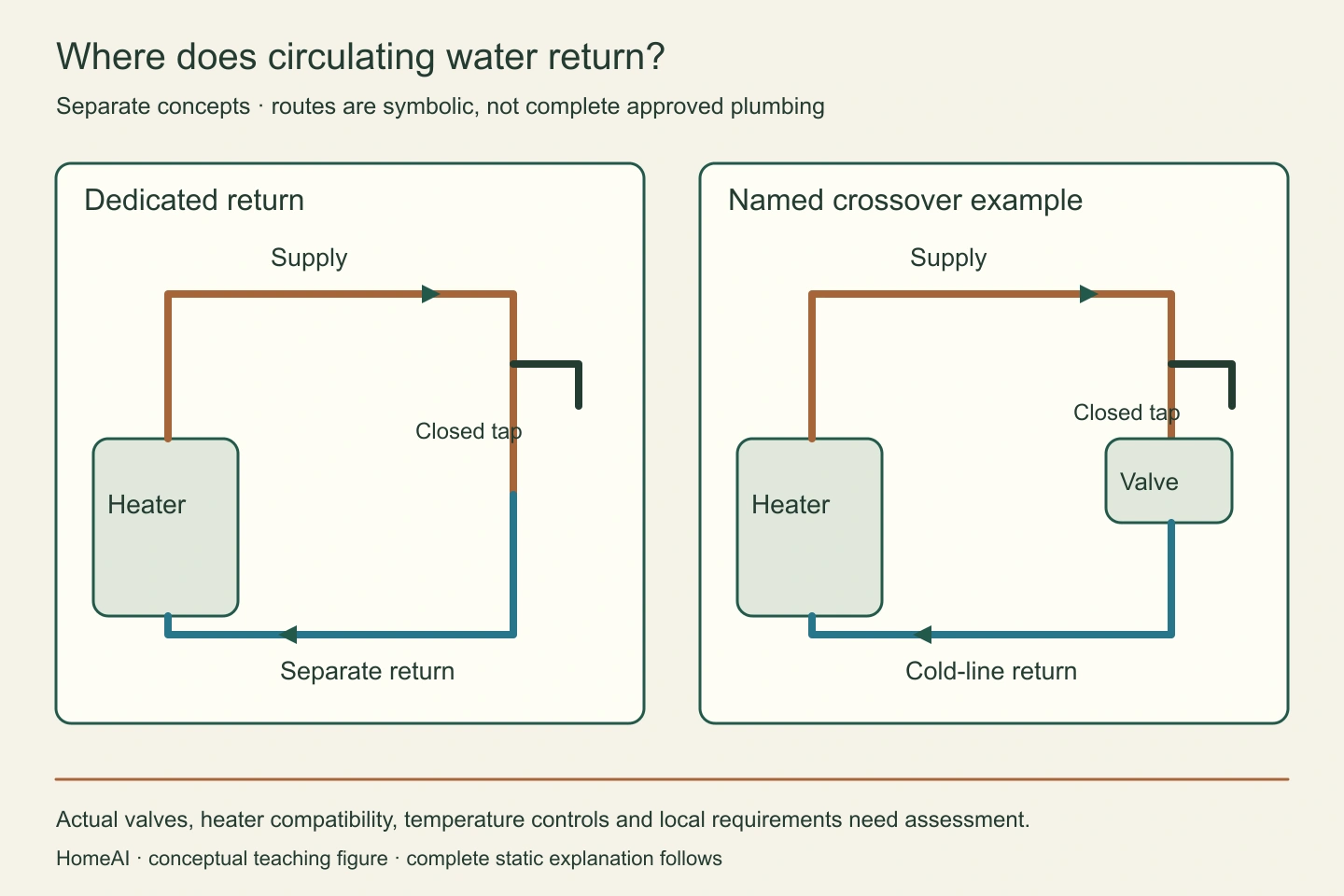
- Dedicated return
Supply and return form an identified loop while a separate branch reaches a closed fixture.
- Named crossover
The manufacturer example uses a documented valve and the cold route; it is not a connection to improvise.
- Closed fixture
Recirculation is different from an ordinary draw out of the spout.
- Return destination
The return must be identified all the way toward the actual heating source.
What does this illustration leave out?
Conceptual relationships only; no actual property finding, measured performance or installation/owner testing procedure. This illustration explains an idea. It is not an installation guide.
Which actual return arrangement and fixtures does the proposal identify?
Explore this with HomeAI ↗Opens an editable question. Nothing is sent until you choose to send it.Two return concepts need separate explanations
A dedicated return brings circulating water back through its own pipe. The named crossover alternative uses the cold line under its intended valve and controls. Neither route discharges through the closed tap.
- Dedicated return
- Supply and return form an identified loop while a separate branch reaches a closed fixture.
- Named crossover
- The manufacturer example uses a documented valve and the cold route; it is not a connection to improvise.
- Closed fixture
- Recirculation is different from an ordinary draw out of the spout.
- Return destination
- The return must be identified all the way toward the actual heating source.
Figure scope: Conceptual relationships only; no actual property finding, measured performance or installation/owner testing procedure.
A useful question: Which actual return arrangement and fixtures does the proposal identify?
Full wording shown in this figure
- Where does circulating water return?
- Separate concepts · routes are symbolic, not complete approved plumbing
- Dedicated return
- Named crossover example
- Heater
- Supply
- Separate return
- Closed tap
- Heater
- Supply
- Valve
- Cold-line return
- Closed tap
- Actual valves, heater compatibility, temperature controls and local requirements need assessment.
- HomeAI · conceptual teaching figure · complete static explanation follows
What do the pump, sensor and controller each contribute?
The circulation pump moves water through its intended circuit. A temperature sensor provides information at its actual installed location. A controller uses its documented logic to request or stop pump operation. A display can report a state or warning, but it is not a direct measurement of every fixture’s delivered water. Keep movement, information and household result as separate relationships.
The named COMFORT10-16 manual distinguishes temperature, timer and adaptive functions across its variants. A temperature-based mode can pause movement according to feedback; a timer mode relates operation to selected periods; an adaptive mode uses recorded demand information. The exact variant matters. Features from a different model must not become instructions for the installed pump.
A demand-type proposal should explain what counts as demand and how that request reaches the equipment. It might not mean a simple button, an open tap or a particular app. Ask for the actual control explanation and ordinary user instructions. Do not add a smart plug or copy an online switching routine to create an assumed demand system.
An unlit indicator, a paused pump and a long wait are different observations. A documented control may intentionally pause; an equipment or supply issue may also need assessment. Record the already noticed state and matching manual identity without repeated switching. Let the provider distinguish expected control behaviour from a fault, and retain both the finding and its assessment limits.
Movement, information and control are different jobs
The pump moves water. The sensor reports its actual location’s condition. A documented controller requests or pauses movement. Timer, temperature and learned patterns are separate model-specific concepts.
Numbers identify the parts explained below.
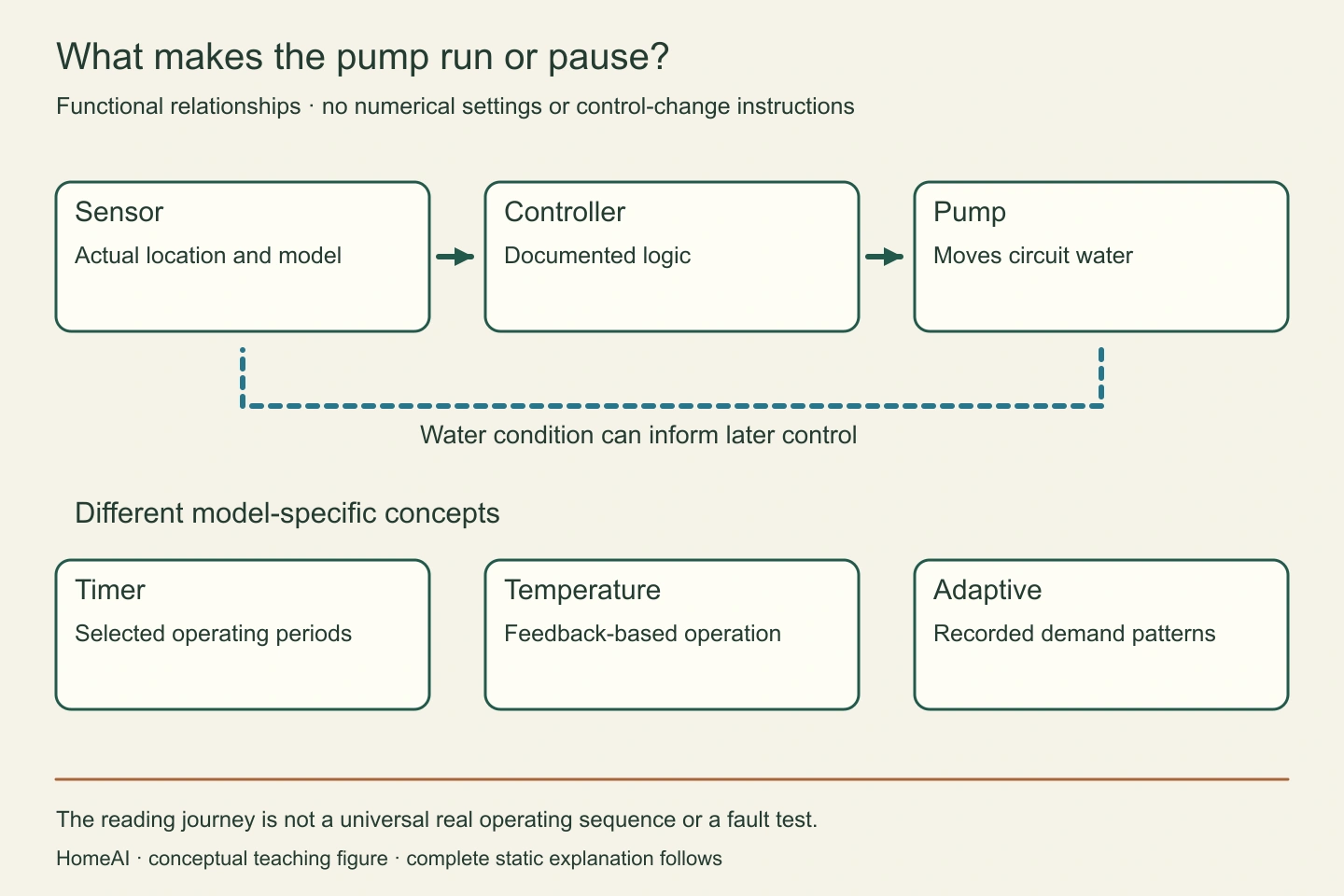
- Movement
A circulator moves water in the identified circuit.
- Feedback
A sensor supplies information from an identified location, not every fixture.
- Control logic
The model’s documented logic decides when pump movement is requested.
- Model-specific variant
Timer, temperature and adaptive features depend on the actual variant and matching manual.
What does this illustration leave out?
Conceptual relationships only; no actual property finding, measured performance or installation/owner testing procedure. This illustration explains an idea. It is not an installation guide.
Which exact variant, sensor location and mode belong to this system?
Explore this with HomeAI ↗Opens an editable question. Nothing is sent until you choose to send it.The pump moves water; a sensor supplies information
The closed circulator represents the water-moving job. The separate small probe illustrates a sensing location, whose information can be used by documented controls. A second insulated pipe appears above; its complete route is not drawn. This is a separate conceptual component study, not a verified close-up of the house picture.
Numbers identify the parts explained below.
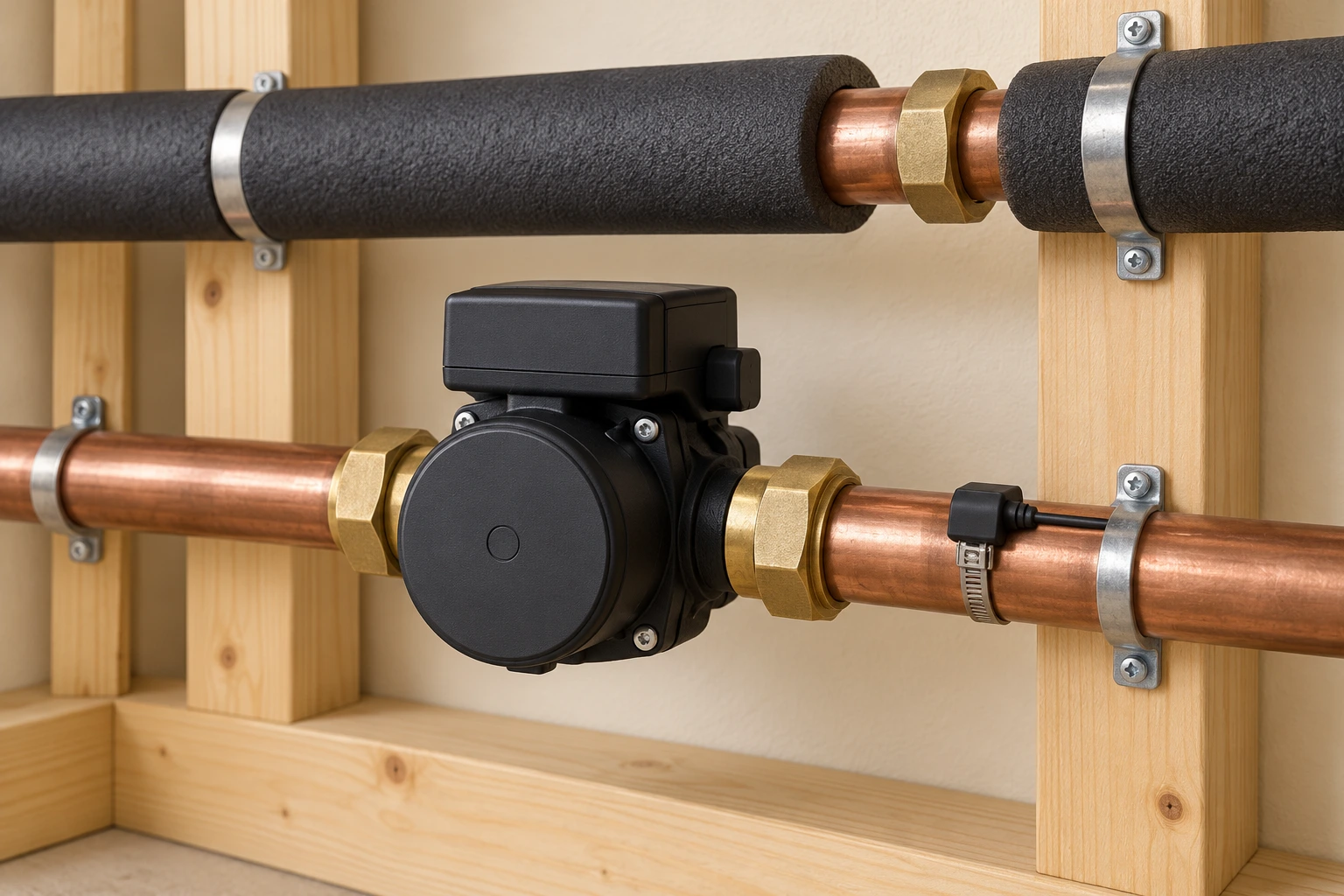
- Closed circulator
Provides the intended movement through the water circuit; internal construction is not exposed.
- Pipe connection
The drawn connection gives context, not approved materials, sizes or installation details.
- External probe
Represents a separate information source whose actual purpose needs identification.
- Upper insulated pipe
Shows a different visible pipe without establishing its destination or function.
What does this illustration leave out?
Internal impeller and control logic, real probe purpose/location, cable route, pipe direction, exact model, insulation suitability and performance remain unestablished. This illustration explains an idea. It is not an installation guide.
Which actual pump, sensor, matching instructions and control mode are documented?
Explore this with HomeAI ↗Opens an editable question. Nothing is sent until you choose to send it.Movement, information and control are different jobs
The pump moves water. The sensor reports its actual location’s condition. A documented controller requests or pauses movement. Timer, temperature and learned patterns are separate model-specific concepts.
- Movement
- A circulator moves water in the identified circuit.
- Feedback
- A sensor supplies information from an identified location, not every fixture.
- Control logic
- The model’s documented logic decides when pump movement is requested.
- Model-specific variant
- Timer, temperature and adaptive features depend on the actual variant and matching manual.
Figure scope: Conceptual relationships only; no actual property finding, measured performance or installation/owner testing procedure.
A useful question: Which exact variant, sensor location and mode belong to this system?
Full wording shown in this figure
- What makes the pump run or pause?
- Functional relationships · no numerical settings or control-change instructions
- Sensor
- Actual location and model
- Controller
- Documented logic
- Pump
- Moves circuit water
- Water condition can inform later control
- Different model-specific concepts
- Timer
- Selected operating periods
- Temperature
- Feedback-based operation
- Adaptive
- Recorded demand patterns
- The reading journey is not a universal real operating sequence or a fault test.
- HomeAI · conceptual teaching figure · complete static explanation follows
Does circulation keep every branch equally ready?
A loop has an actual extent. A short branch between the loop and a fixture remains a separate piece of distribution. Other rooms can have different routes. The most distant room on a floor plan is not necessarily the end of the installed loop. A useful assessment identifies the served plumbing rather than relying on the room’s apparent distance.
The manufacturer’s fault discussion includes branch balancing and sensor location among possible investigation topics. Those are professional questions, not owner adjustments. A branch concern cannot establish a balancing defect on its own. Ask whether the provider assessed the whole distribution or only one visible pump and a single outlet, and which other branches remained outside the visit.
The route figure therefore shows a loop, a branch and a separate unconfirmed destination. It uses no pipe diameter, capacity, flow target or performance curve. Its task is to help a reader ask which parts of the home the proposal covers. More lines in a drawing do not mean that every outlet receives identical service.
In a condominium or apartment, a household may not control the return, riser or central heater. Report the locations and ordinary-use pattern to management before arranging changes. Establish who owns and services each part, whose permission is needed, and who coordinates a wider investigation. A private fixture repair and shared circulation work need different scopes and records.
How should I describe a changed wait without testing the system?
Write down an already noticed change in normal use: which fixture, approximate date, whether it followed a long unused period, and whether another room was affected. Include recent work or a power interruption if known. An ordinary account is useful even when no stopwatch, temperature reading or route drawing exists. Unknown entries can stay unknown.
Separate first-arrival waiting from water becoming cool during continued use. Also distinguish a local tap-control concern from a whole-home change. These descriptions lead to different questions about heating, distribution and delivery. Do not run repeated draws, touch pipework or change valves to decide which explanation fits. Your account should help the professional choose a method.
If a matching display already shows a message from safe access, preserve the wording and model information. A colour alone is not a universal fault code. The same product family can contain variants with different controls. Ask the provider to translate the observed state into a bounded explanation, rather than treating a screenshot of an app as a complete performance report.
Hot water and pressurized equipment can cause injury, while pumps also involve electricity. Keep away from leaks, exposed electrical parts and hot surfaces. Do not open the pump, bleed a line, remove a cover or alter temperature settings for this guide. Immediate danger takes priority over collecting evidence; use appropriate urgent assistance instead of extending the observation.
Could the explanation involve something other than the pump?
Yes. A distribution route that was never served, a changed control state and an equipment fault are different possibilities. A heater or fixture issue can also change what a person experiences. Listing alternatives does not say they are equally likely. It helps prevent a single familiar component from becoming the answer before anyone defines the actual symptom.
The named manufacturer manual discusses multiple causes for stopped or noisy operation, and cases where control intentionally waits. Those distinctions support qualified assessment. They do not justify trying each remedy. A homeowner should not vent, dismantle, replace a sensor or change a mode to eliminate possibilities. The provider should choose work appropriate to the actual model and concern.
Ask for a sequence of reasoning in the report: what was observed, which system state applied, what method was used, what finding followed, and what remained unassessed. A note saying pump checked is too broad to explain whether a component operated, a route was identified or fixture delivery was measured. Request a plain-language statement of the specific completed task.
A repaired part may resolve the assigned concern without assessing all concealed pipes or every household operating pattern. Keep that success at its actual scope. If a second room still has a different issue, record it separately and discuss the appropriate next step. The answer should follow the household question, not expand a narrow invoice into a whole-system certificate.
How should water convenience and energy claims be compared?
Recirculation can reduce waiting for suitable hot water by changing distribution. That does not make water convenience, pump electricity and heat supplied to the pipe one quantity. A proposal should say which result it estimates and which assumptions it uses. A product’s motor power alone cannot establish the overall household energy effect.
NRCan presents demand-type circulation within broader hot-water distribution choices. Read that as a reason to examine route and control, not as a promised saving for every home. Compare the complete proposed arrangement, actual household use and alternatives. Avoid treating a manufacturer’s broad marketing statement as a metered Canadian household result or a guaranteed payback period.
A useful comparison keeps the same household purpose and observation period. What water use is included? What energy inputs and heating effects are included? What is measured, what is estimated and what has not been assessed? If the provider supplies a calculation, retain units and assumptions beside the result. A lower bill after unrelated changes cannot isolate the pump’s effect.
The figure uses separate evidence columns for waiting, water quantity, electricity and heat. It intentionally supplies no savings percentage or numerical curve. The next useful action is to obtain an intelligible explanation of the proposed trade-offs. Installation cost, access and future service also belong in the owner’s decision, with actual quotations kept separate from generic education.
Four questions need four evidence boundaries
Waiting at a fixture, water quantity, pump electricity and heat supplied to distribution are different questions. An estimate or bounded check should identify its units, period, conditions and exclusions.
Numbers identify the parts explained below.
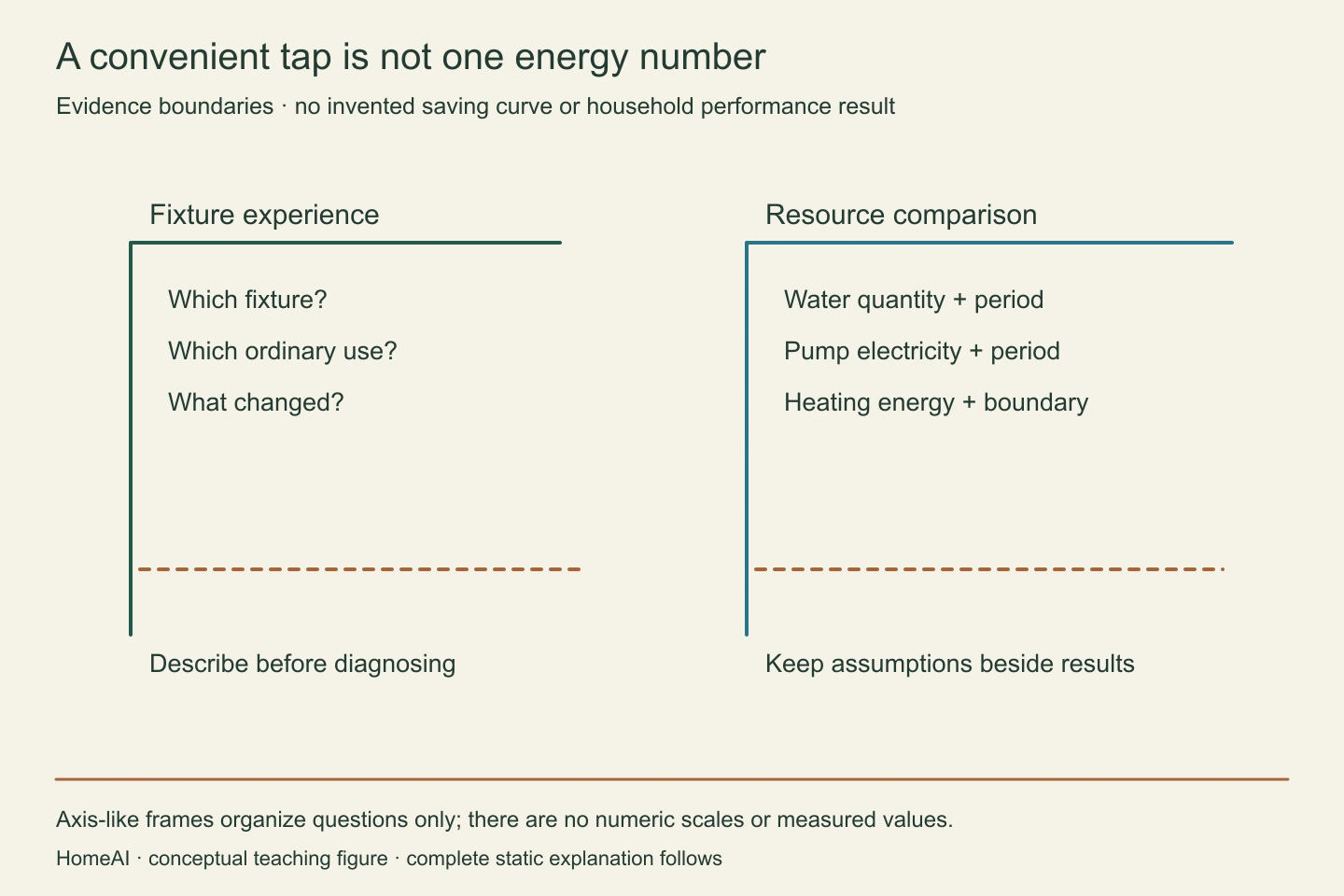
- Waiting
Identify the fixture and ordinary-use context; no stopwatch test is requested.
- Water quantity
Any quantity needs an actual method, units and observation period.
- Electricity
Name the included electrical loads and time boundary.
- Heat and energy
A whole-system comparison must explain what heating and other changes are included.
What does this illustration leave out?
Conceptual relationships only; no actual property finding, measured performance or installation/owner testing procedure. This illustration explains an idea. It is not an installation guide.
Which result is measured, which is estimated and what is outside the comparison?
Explore this with HomeAI ↗Opens an editable question. Nothing is sent until you choose to send it.Four questions need four evidence boundaries
Waiting at a fixture, water quantity, pump electricity and heat supplied to distribution are different questions. An estimate or bounded check should identify its units, period, conditions and exclusions.
- Waiting
- Identify the fixture and ordinary-use context; no stopwatch test is requested.
- Water quantity
- Any quantity needs an actual method, units and observation period.
- Electricity
- Name the included electrical loads and time boundary.
- Heat and energy
- A whole-system comparison must explain what heating and other changes are included.
Figure scope: Conceptual relationships only; no actual property finding, measured performance or installation/owner testing procedure.
A useful question: Which result is measured, which is estimated and what is outside the comparison?
Full wording shown in this figure
- A convenient tap is not one energy number
- Evidence boundaries · no invented saving curve or household performance result
- Fixture experience
- Which fixture?
- Which ordinary use?
- What changed?
- Resource comparison
- Water quantity + period
- Pump electricity + period
- Heating energy + boundary
- Describe before diagnosing
- Keep assumptions beside results
- Axis-like frames organize questions only; there are no numeric scales or measured values.
- HomeAI · conceptual teaching figure · complete static explanation follows
What needs to be in a professional proposal?
Begin with the affected fixture and desired result, then identify the existing heater and distribution as far as records allow. Ask the provider to describe the proposed circulation route, pump, controls and any fixture or temperature-control effects. The offer should say which problems it intends to address and which findings must precede a final design.
Request a scope for plumbing, electricity, access, restoration and applicable local permissions. Requirements vary by location and work. Manufacturer instructions are product information, not nationwide authorization. Confirm the appropriate qualifications and authority process for the address. Shared systems need management involvement; a provider’s ability to work in one unit does not establish permission to change a common route.
Completion should identify the actual installed components and explain the ordinary controls. Ask which delivery functions were checked, under what conditions, with what findings and exclusions. Sizing, temperature management, water-quality protection and concealed route verification need their own relevant scopes. A neat pipe installation or a functioning app is not a substitute for that account.
Keep the original proposal and approved changes beside the completion record. If a route or device differs from the quotation, request the reason and updated documentation. A HAUSE introduction or an AI guide supplies no credential, availability or inspection finding. The contractor-management guide helps carry an agreed task through changes and handover without silently expanding what anyone promised.
Fictional example: does a new heater fix one distant bathroom?
This is an invented household. Mara’s kitchen receives suitable hot water during ordinary use, while the upstairs bathroom has a first-use wait. An older heater invoice identifies the equipment but says nothing about a return route. A nearby small pump is visible from the doorway. None of these facts establishes its purpose or the cause of the bathroom concern.
Mara gives a plumber the existing documents and an ordinary-use account. The assignment asks for equipment and route identification before a replacement recommendation. In the fictional report, the provider identifies a dedicated loop serving one branch, while a concealed bathroom branch remains outside that first visit. The report does not diagnose the unassessed branch from the photograph.
A later fictional proposal offers a defined investigation of that branch and explains the relevant control. Mara compares its purpose, access and completion evidence with the separate option of replacing the heater. The story supplies no approved route, measured wait, cost, temperature or repair result. It demonstrates how a useful scope can prevent a distribution concern from becoming an automatic heater purchase.
The final fictional file retains three distinct statements: the heater identity is documented, one circulation route was identified, and a different branch needs an agreed follow-up if the household wishes to resolve its concern. The next person can understand those limits without assuming every unknown is defective. This is a record example, not a diagnosis or recommendation for a real home.
Mara’s fictional route has one unassessed branch
One identified loop can serve one branch while another route remains unconfirmed. The heater record, loop finding and next branch assessment keep their separate scopes.
Numbers identify the parts explained below.
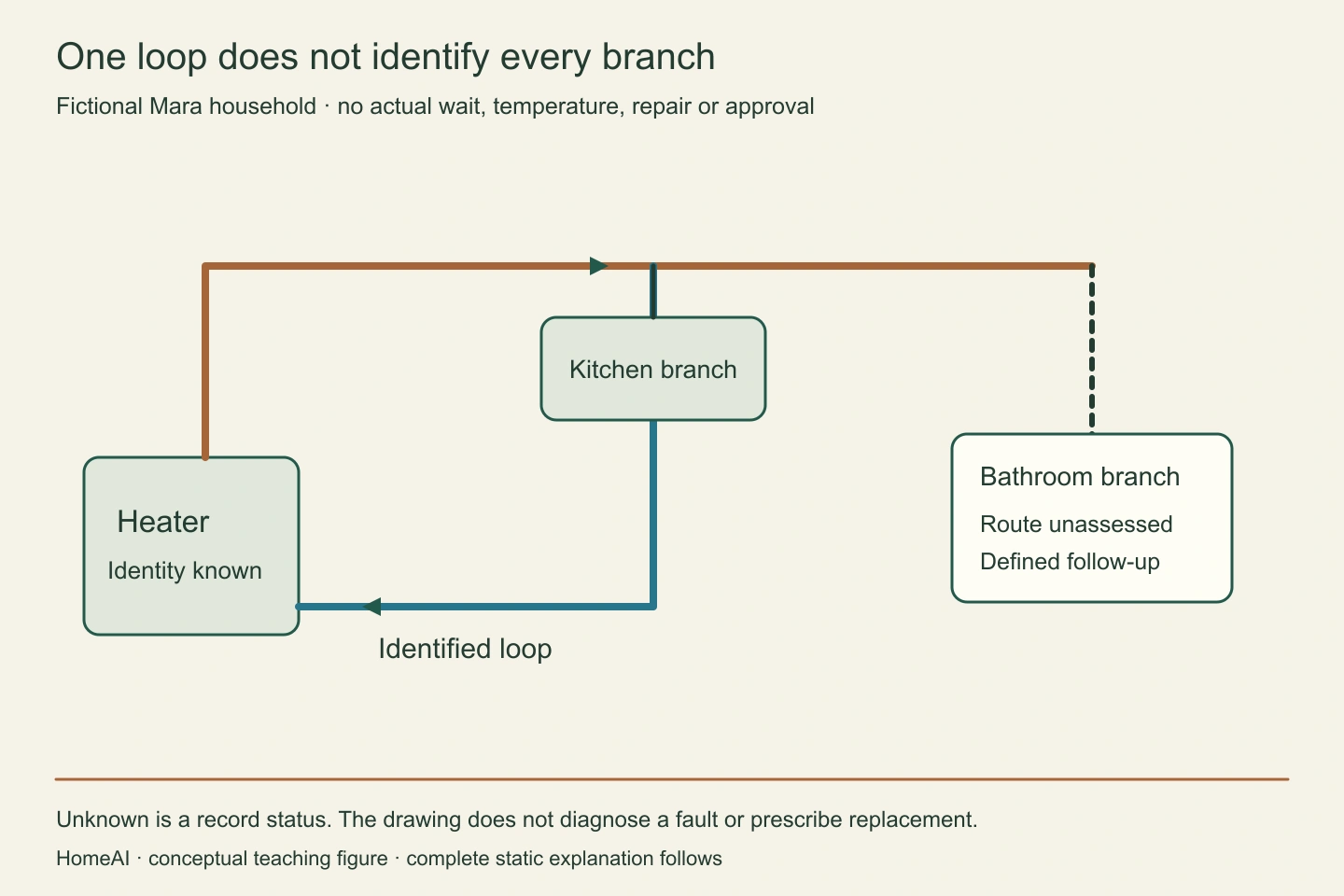
- Heater identity
An existing invoice identifies equipment but not the entire distribution.
- Identified loop
A provider can identify one covered route without clearing every branch.
- Unassessed branch
The fictional bathroom remains a defined next question, not a diagnosed defect.
- Next assignment
Define the affected bathroom branch assessment before selecting a replacement.
What does this illustration leave out?
Conceptual relationships only; no actual property finding, measured performance or installation/owner testing procedure. This illustration explains an idea. It is not an installation guide.
What does the actual record establish about the affected bathroom?
Explore this with HomeAI ↗Opens an editable question. Nothing is sent until you choose to send it.Mara’s fictional route has one unassessed branch
One identified loop can serve one branch while another route remains unconfirmed. The heater record, loop finding and next branch assessment keep their separate scopes.
- Heater identity
- An existing invoice identifies equipment but not the entire distribution.
- Identified loop
- A provider can identify one covered route without clearing every branch.
- Unassessed branch
- The fictional bathroom remains a defined next question, not a diagnosed defect.
- Next assignment
- Define the affected bathroom branch assessment before selecting a replacement.
Figure scope: Conceptual relationships only; no actual property finding, measured performance or installation/owner testing procedure.
A useful question: What does the actual record establish about the affected bathroom?
Full wording shown in this figure
- One loop does not identify every branch
- Fictional Mara household · no actual wait, temperature, repair or approval
- Heater
- Identity known
- Identified loop
- Kitchen branch
- Bathroom branch
- Route unassessed
- Defined follow-up
- Unknown is a record status. The drawing does not diagnose a fault or prescribe replacement.
- HomeAI · conceptual teaching figure · complete static explanation follows
What should the final circulation handover make clear?
A helpful handover lets an ordinary reader follow the water: heating source, served supply, fixture branch, return and circulation equipment. Add actual component identities, matching manual editions, documented control mode and the provider’s explanation of ordinary use. Keep the plan legible and date any later changes rather than overwriting the original arrangement.
Retain service contacts, relevant local completion documents, agreed care responsibilities and the written response to the original concern. A maintenance schedule should come from the actual equipment and provider, not from this conceptual lesson. If an app is involved, establish who owns access and how ordinary control works when connectivity changes. Do not place account secrets in a shared property file.
The controlled journey remains a teaching aid after installation. Its reading cycle is not the equipment’s real operating duration, and its coloured routes do not measure temperature or flow. Use the complete static explanations when motion is paused or unavailable. Compare the model with the actual provider’s route account to identify the next unanswered question.
The outcome to seek is specific: understand why water moves, where it returns, which fixtures are served, what requests movement and what evidence addresses the original wait. That is more useful than a generic promise of instant hot water. Keep heating, potable-water protection, household energy and shared-building responsibility connected through their own records and specialist advice.
Keep learning about the connected parts
- Your water heater: build the right maintenance record
- How home plumbing works: supply, drains, vents and pipe materials
- Apartment water systems: risers, central hot water and shared response
- Drinking-water backflow: understand connections and protection
- Why is my energy bill higher? Read the quantity, dates and charges
Canadian context and authorities · Visual atlas · Learning labs
Practice the distinction.
Mara’s fictional distant bathroom
An invented heater invoice and visible pump do not identify the bathroom route.
Reported observations
- Kitchen delivery and bathroom first-use waiting are separate ordinary reports.
- The heater identity is documented.
- A concealed branch remains outside the first assessment.
Compare the explanations
Expand each possibility to see the evidence needed to distinguish it. Similar symptoms can have different mechanisms.
A distribution question may remain
Identifying one loop does not identify every branch.
Appropriate route and delivery assessment.
Replacing the heater may address a different task
Equipment and distribution have distinct jobs.
A proposal tied to actual findings and the household question.
A useful next question
Request the defined branch assessment and compare its scope with any equipment proposal.
Fictional record only; no actual temperature, wait, cost, approval or repair outcome.
Know what the words mean.
- Recirculation
- Water movement around an identified supply-and-return route, rather than every movement ending at an open fixture.
- Dedicated return
- A separate pipe route bringing circulating water back toward the heating source.
- Fixture branch
- The connection between distribution and an individual outlet; its actual extent needs identification.
- Circulator
- A pump intended to move water around the relevant circuit.
- Temperature feedback
- Information from an actual sensor location used by a documented control.
- Crossover arrangement
- A named product arrangement in which hot and cold distribution interact under its intended valve and controls; not a connection to improvise.
Questions to bring
to the conversation.
- Which actual route and fixtures are served?
- Which pump, sensor and control mode are documented?
- What work and findings address the original household concern?
- What assumptions support any water or energy estimate?
Separate a showing observation, an existing record and a new professional assessment. Unknown means a question remains; it does not automatically mean a defect.
Use the evidence planner ↗Go to the source.
Original HomeAI explanation informed by these public references. Sources support the underlying guidance; they have not reviewed or endorsed HomeAI. Diagrams are conceptual, and calculator outputs depend on your inputs.
Sources were read October19,2026 in America/Edmonton (October20UTC). NRCan federal education, the named Grundfos Canada overview, COMFORT10-16 English technical manual99836602 July2025 and Taco SmartPlus102-516 May2024 have different scopes. Product examples explain distinct return and control arrangements; none approves a route or supplies household performance. Local requirements and the actual matching instructions remain necessary. The household example is fictional.
Publication & source review
First published .
Sources reviewed .
Have a question about your home?
Start with the symptom, timing and what you have observed.
Ask HomeAI