- Frost can form because the outdoor coil is colder than the air; temperature and moisture matter together.
- A defrost-like pause, visible vapour and meltwater are observations whose interpretation depends on identified equipment and the complete sequence.
- Keep coil condition, drainage, room comfort, displayed mode and measured energy in separate records before requesting qualified assessment.
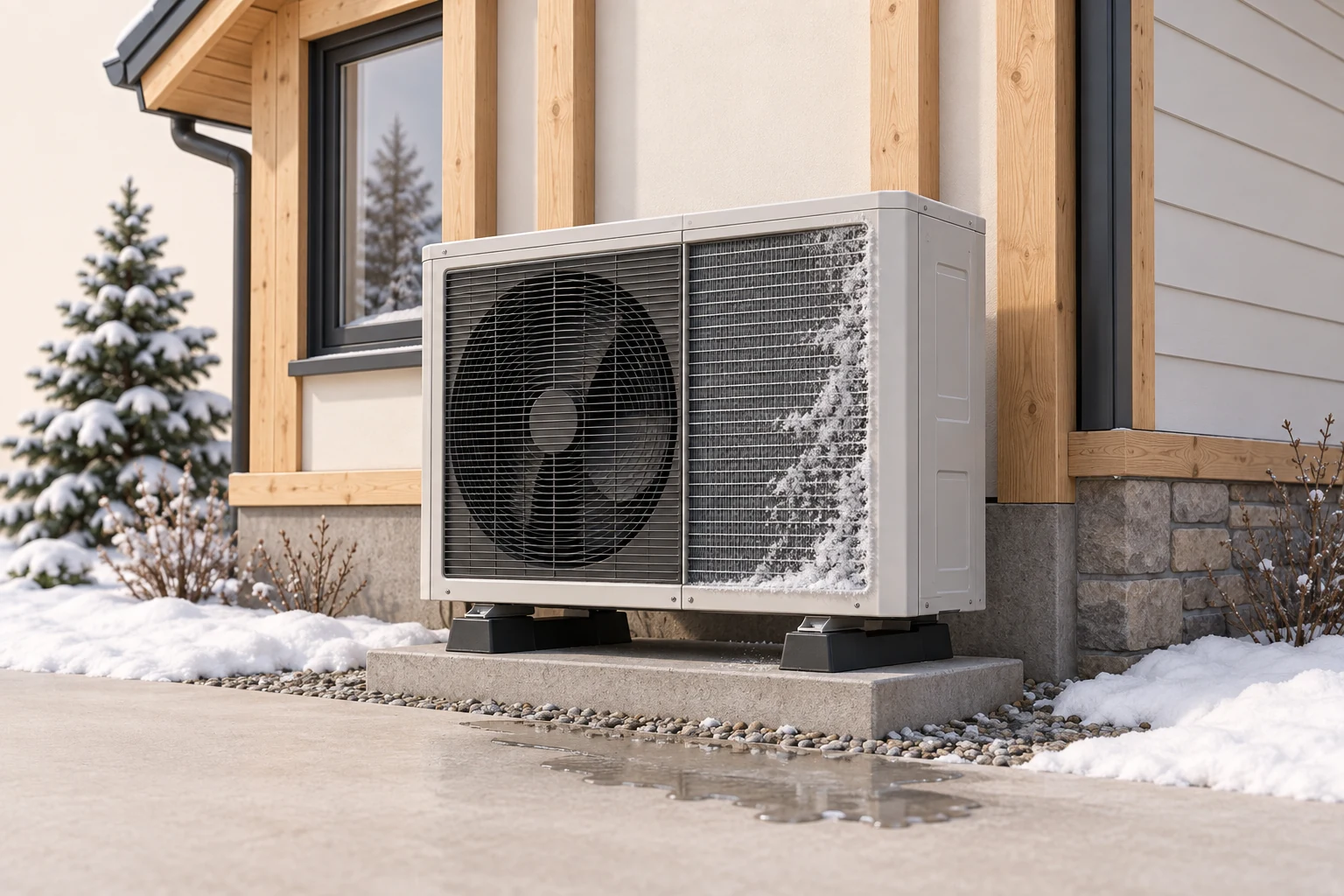
The illustration shows a fan grille, part of a finned surface with frost, snow nearby and water on the ground. It is a teaching scene, not a photographed installation.
About this illustration
The actual coil arrangement, operating mode, event sequence, weather, temperature, drainage route, clearances and cause remain unknown. Frost or a puddle alone establishes neither normal operation nor a fault. This is a conceptual teaching model, not an assessment of your home.
3 picture lessons appear beside the questions in this guide. Use them to understand the explanation, then consider what it means for your home.
Why can the outdoor coil frost when the air does not feel extremely cold?
An air-source heat pump takes energy from outdoor air during heating. For that transfer to occur, the working refrigerant in the outdoor heat exchanger is colder than the air passing across it. Moisture can collect on a sufficiently cold surface and freeze. The relevant surface is the coil, which need not have the same temperature as a weather report or the surrounding air.
Frost is therefore a heat-and-moisture question. NRCan describes outdoor temperature and airborne moisture as factors in accumulation. A damp period near freezing can present a different frost pattern from a colder, drier period. Comparing photographs by outdoor temperature alone leaves out both surface conditions and moisture.
Accumulated frost interferes with heat exchange; its removal is part of the operating cycle. This guide concerns outdoor-air systems. A ground-source system has a different source arrangement, so do not transfer an outdoor-coil explanation merely because both products are called heat pumps. Identify the actual system before interpreting its behaviour.
Frost, meltwater and the room are different observations
The illustration shows a fan grille, part of a finned surface with frost, snow nearby and water on the ground. It is a teaching scene, not a photographed installation.
Numbers identify the parts explained below.
- Finned region
A cold outdoor heat-exchange surface can collect moisture and frost under suitable conditions. The illustrated frost pattern cannot identify the actual mode or health of a system.
- Closed cabinet
Keep covers closed. Match observations to the actual model manual and professional findings; the visible fan does not prove measured airflow or output.
- Ground water
Meltwater and where it goes are separate questions. The scene provides no approved drainage or refreezing design.
What does this illustration leave out?
The actual coil arrangement, operating mode, event sequence, weather, temperature, drainage route, clearances and cause remain unknown. Frost or a puddle alone establishes neither normal operation nor a fault. This illustration explains an idea. It is not an installation guide.
What should I record about frost, defrost, meltwater and indoor comfort so a qualified heat-pump professional can interpret my winter observations?
Explore this with HomeAI ↗Opens an editable question. Nothing is sent until you choose to send it.What changes during a reverse-cycle defrost event?
NRCan describes reverse-cycle defrost as a common approach: the refrigerant cycle changes so the outdoor coil receives heat that melts frost. The outdoor fan may stop during that sequence. The system temporarily devotes energy to clearing the outdoor heat exchanger rather than its usual indoor heating task.
The indoor response depends on equipment and controls. Air delivery may change or pause, and an available supplementary heating system may contribute. Those possibilities are reasons to read the matching manual and operating plan; they do not establish that every home has electric resistance strips, a furnace or the same fan sequence.
Think in three linked phases: ordinary heating, frost removal and return to the commanded operation. A brief observation of the middle phase cannot establish how the event began or ended. A teaching animation can show that sequence, but it cannot supply a real duration, control trigger, refrigerant condition or confirmed defrost command for your property.
Does a stopped fan or white plume mean everything is normal?
A stopped fan is a visible state, rather than a complete explanation. A white plume can be consistent with water vapour during frost removal, but colour alone does not identify its source. Read the outdoor observation together with the commanded mode, indoor response, subsequent operation and any visible code.
For a concrete manufacturer example, the Mitsubishi MSZ-GS18NA instructions describe a heating interruption during defrost, meltwater and vapour that can resemble white smoke. The same PDF includes the MSY-GS18NA cooling-only model. Match the model and heat-pump section instead of treating every statement in the document as applicable to all products.
The example explains a possible sequence; it does not clear unfamiliar smoke, burning odour or damaged electrical equipment. Never approach a suspicious plume to identify it by smell. If there is fire, smoke or immediate danger, move to safety and obtain emergency help. A suspected CO alarm or gas leak follows its own urgent response, even when a heat pump is present.
How do coil frost, meltwater and ground ice raise different questions?
Frost on the heat exchanger concerns the surface from which heat is being extracted. Water leaving after melting concerns drainage. Ice on the ground concerns where water arrived and froze. These locations may be related, but they are not interchangeable diagnoses. Water falling from another part of the building introduces a separate possible source.
From a safe accessible position, describe the location in plain words and preserve the date of any photograph. Note whether the coil face was visible or obscured. A later photograph of clear fins does not establish whether an earlier concealed area cleared, just as ground ice does not independently prove a failed defrost control.
Ask the equipment professional to distinguish frost-removal operation from drainage, siting and surrounding water exposure. The named Mitsubishi instructions explicitly describe water produced during outdoor defrost. That supports a meltwater mechanism, without establishing that a particular pool, blocked route or icy walkway is an acceptable installation. Stay clear of slippery areas and do not improvise a drain alteration.
Frost, meltwater and the room are different observations
The illustration shows a fan grille, part of a finned surface with frost, snow nearby and water on the ground. It is a teaching scene, not a photographed installation.
Numbers identify the parts explained below.
- Finned region
A cold outdoor heat-exchange surface can collect moisture and frost under suitable conditions. The illustrated frost pattern cannot identify the actual mode or health of a system.
- Closed cabinet
Keep covers closed. Match observations to the actual model manual and professional findings; the visible fan does not prove measured airflow or output.
- Ground water
Meltwater and where it goes are separate questions. The scene provides no approved drainage or refreezing design.
What does this illustration leave out?
The actual coil arrangement, operating mode, event sequence, weather, temperature, drainage route, clearances and cause remain unknown. Frost or a puddle alone establishes neither normal operation nor a fault. This illustration explains an idea. It is not an installation guide.
What should I record about frost, defrost, meltwater and indoor comfort so a qualified heat-pump professional can interpret my winter observations?
Explore this with HomeAI ↗Opens an editable question. Nothing is sent until you choose to send it.Which weather and household context makes a log useful?
Record the observation time, reported outdoor temperature and where that weather information came from. Add visible precipitation or snow conditions without claiming measured local humidity if none was recorded. A weather station several kilometres away provides context; it is not a reading of coil temperature or the unit’s own sensor.
Include the ordinary thermostat mode and setpoint, changes made before the event, approximate room temperature and affected rooms. Mark outages and known service or filter changes. Separate a display reading from a value reported by another person. Uncertain time should remain approximate rather than being assigned a precise minute later.
BC Hydro’s cold-climate explanation connects performance to model selection and the existing home, while HPSC’s contractor guide treats occupant comfort and controls as part of the system. A useful comparison therefore keeps weather and household operation beside the event. Several unlike days do not become a controlled performance test merely because they occupy consecutive log rows.
How should I record the event without forcing a test?
Use events noticed during ordinary use. Start the entry with what was directly observed: fan quiet at a stated time, changed air delivery, visible water or a displayed symbol. Keep interpretation in a separate column labelled reported or suspected defrost until the manual or professional record supports it.
If you noticed the beginning and end, preserve both times. If you arrived midway, write observed for part of the event; the elapsed observation is not its total duration. Likewise, two separated sightings cannot prove continuous operation between them. Record whether heating appeared to resume and how the room responded afterward.
Do not change installer settings, force defrost, cycle a breaker or disconnect sensors to obtain a more complete log. Do not insert a thermometer, tool or camera into equipment. The Mitsubishi manual identifies rotating parts and electric-shock hazards and excludes user disassembly or repair. An incomplete safe record is more useful than an improvised test that changes the event or creates a hazard.
Why might supplementary heat appear, and what does the display prove?
The home’s supplementary system, if present, has a purpose and control arrangement that must be identified. It may support heating when heat-pump capacity does not cover the assessed need, or contribute during defrost in an applicable configuration. A separate heating appliance in the house is not proof that it is integrated into the heat pump’s control sequence.
An AUX or other display label tells you what that identified controller reports. Ask the installer what it means for this arrangement and whether the indication describes a command or confirmed equipment operation. It is not a measurement of heat supplied, electrical demand, fuel use or refrigerant condition.
The HPSC guide discusses different supplementary-control arrangements in a British Columbia retrofit context. Use it to frame a question about your documented configuration rather than copy its installer adjustments. Retain the equipment list, accepted operating explanation and any subsequent professional changes together. No single outdoor temperature in this article defines when every Canadian home should switch heat sources.
Can runtime or a higher bill tell me the defrost efficiency?
Longer operation can occur without proving a fault. Useful heat delivery, the building’s heat need, distribution, controls and weather all affect the comfort result. A room staying comfortable and an outdoor unit running longer describe different parts of the observation. Hand-feeling a grille does not quantify output.
Electricity records accumulate the home’s consumption over their stated period. They can reveal a change worth discussing, but usually include other loads and possibly supplementary heating. A billed dollar amount also depends on rates and charges. Neither the bill nor a count of defrost-like events gives the system’s coefficient of performance.
For a performance question, ask the qualified professional which output and input measurements are appropriate, what equipment boundary they cover and which operating conditions support comparison. A catalogue efficiency and an unrelated home-meter total cannot form a field COP. Keep this event log as service context, alongside any distinct energy assessment, rather than label it a seasonal savings verification.
A route is different from a tested system
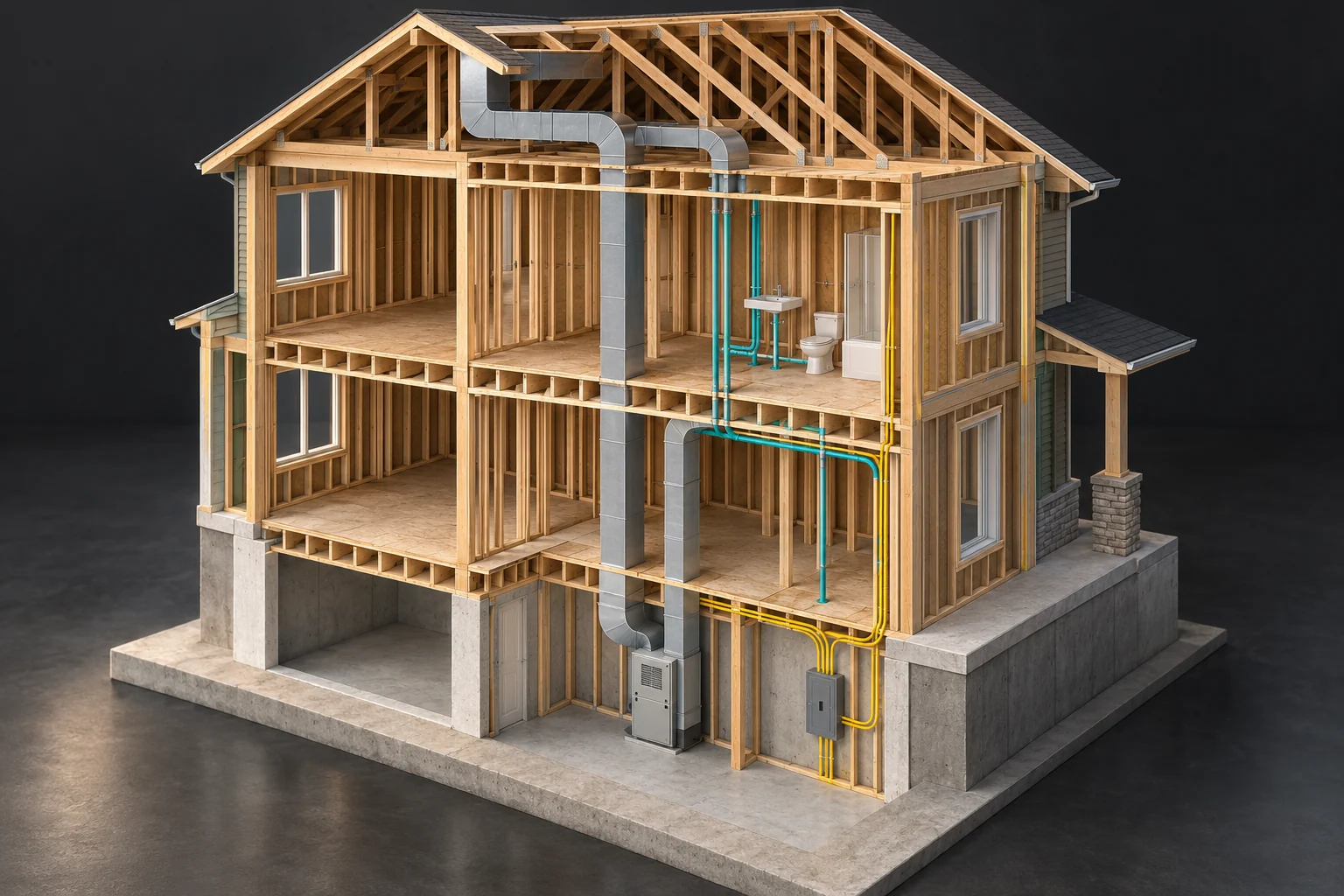
Visible routes locate different system functions. Closed equipment keeps this a planning illustration.
Numbers identify the parts explained below.
- Routes
Trace the question using records; colour is only this illustration’s key.
- Closed equipment
A professional defines access and measurements. Do not open a panel for this lesson.
- Room endpoint
A symptom at one room does not locate the fault.
What does this illustration leave out?
Capacity, continuity, hidden condition, electrical safety and actual delivered performance are not established. This illustration explains an idea. It is not an installation guide.
Which safe observations and specific professional measurements would resolve this system question?
Explore this with HomeAI ↗Opens an editable question. Nothing is sent until you choose to send it.Which owner actions belong to the matching maintenance instructions?
Learn the ordinary controls and owner maintenance demonstrated for the identified equipment. Keep accessible air paths unobstructed in the manner specified by the instructions, and report visible snow accumulation that blocks outdoor equipment. Arrange a professional maintenance plan suited to the system rather than infer an interval from its appearance.
Observation does not require touching coils or entering the fan opening. Do not chip ice, apply hot water, chemical de-icer or an improvised heater, and do not remove guards. If access requires climbing, crossing ice or working near electrical equipment, stop and arrange appropriate help. The purpose is to preserve equipment and personal safety while the cause is assessed.
HPSC’s homeowner handover checklist includes model identity, owner instructions, maintenance, installation and commissioning records, and an explanation of vapour and frost. This is a useful orientation model. It is not a national entitlement to a particular checklist or permission for an owner to undertake the refrigerant, airflow or electrical measurements described elsewhere in that contractor guide.
What does a fictional changed-pattern case teach?
A fictional owner first notices a plume and reduced indoor air delivery on a damp morning. They see heating resume later and the living room remains comfortable. A week afterward they report persistent visible frost and a cooler living room, but do not know when the suspected event began or whether it completed. These are separate entries with different evidence.
The first entry is compatible with a described defrost sequence, without certifying that it was one. The second changes the service question: which operation, frost-removal, drainage or delivery explanation fits the complete system? The owner supplies model details, weather context, ordinary settings and dated pictures taken safely. They avoid naming a failed valve or assuming refrigerant needs adding.
Suppose the technician assesses a specific operating condition and supplies findings with their method and limitations. Store that report separately from the owner’s earlier hypothesis, along with any accepted work and follow-up. The fictional example invents no repair finding, normal duration, success rate or warranty outcome. Its result is a clearer service assignment supported by an honest chronology.
When should a service question become a prompt or urgent action?
Persistent frost, changed operation, unexplained repeated events, failure to regain expected comfort or a visible code deserve contact with the qualified service provider. Ask which response the matching manual requires and describe the observed change. Do not wait for a perfect log if heat loss threatens occupants or the building.
Ask the professional: which mode and sequence did you verify; what manufacturer expectation applies; what remains unknown about drainage, controls or indoor delivery; and what follow-up is appropriate? Keep an observed condition, a diagnosis, completed work and verified follow-up as distinct entries. A report from mild weather does not automatically assess operation in every future cold condition.
A CO alarm overrides the ordinary service conversation: leave immediately and call emergency services from outside without seeking the source. For suspected gas, leave without operating electrical switches or creating ignition sources, then contact the applicable utility or emergency services outside. Smoke, sparks or electrical burning conditions require staying clear and appropriate urgent help. These boundaries apply without assuming the heat pump itself burns fuel.
Practice the distinction.
A changed frost-and-comfort pattern
Fictional learning scenario: one observed plume is followed a week later by reported persistent frost and poorer room comfort.
Reported observations
- The model and ordinary settings can be recovered.
- The first event was seen only partly.
- The second report includes a changed comfort pattern.
- No qualified operating finding exists yet.
Compare the explanations
Expand each possibility to see the evidence needed to distinguish it. Similar symptoms can have different mechanisms.
A documented frost-removal sequence
Some observed states may fit the identified manual’s defrost explanation.
Complete sequence, model-specific expectations and relevant professional verification.
A changed system condition needs assessment
Frost, drainage, controls and delivery raise distinct possible service questions.
Scoped equipment and site findings under documented conditions.
A useful next question
Provide a safe chronology and request a qualified assessment of the changed pattern.
No photo diagnosis, normal-duration threshold, refrigerant instruction or seasonal-efficiency conclusion.
Know what the words mean.
- Outdoor evaporator
- The outdoor heat exchanger acting as the heat-absorbing coil during heating in an air-source system.
- Reverse-cycle defrost
- A frost-removal sequence that changes the refrigerant cycle to deliver heat to the outdoor coil.
- Meltwater
- Liquid water produced as frost or ice melts; its drainage and later freezing require their own context.
- Supplementary heat
- An identified additional heat source supporting the system under its documented operating arrangement.
- Observed interval
- The portion of an event actually witnessed, which may be shorter than its complete duration.
- Commanded mode
- The operation requested by the control, distinct from independently verified equipment response.
Questions to bring
to the conversation.
- Which outdoor unit, indoor units and controller does the owner manual actually cover?
- What happened before, during and after the reported event, and which times were actually observed?
- Where was the ice: coil face, base, ground, another surface or an unknown location?
- Did the controller show a mode or code, and did ordinary heating and room comfort recover?
- What weather, thermostat changes, outages or maintenance changes accompanied the observation?
- Which specific manufacturer expectation and service finding support the professional interpretation?
Separate a showing observation, an existing record and a new professional assessment. Unknown means a question remains; it does not automatically mean a defect.
Use the evidence planner ↗Go to the source.
Original HomeAI explanation informed by these public references. Sources support the underlying guidance; they have not reviewed or endorsed HomeAI. Diagrams are conceptual, and calculator outputs depend on your inputs.
Publication & source review
First published .
Sources reviewed .
- Natural Resources Canada · Heating and cooling with a heat pump
- Mitsubishi Electric Canada · MSZ-GS18NA operating instructions
- Mitsubishi Electric Canada · Homeowner heat-pump questions
- HPSC / BC Hydro · Heat Pump Retrofit Best Practices Guide for Contractors, version 2
- BC Hydro · How heat pumps measure up against cold climates in B.C.
- Health Canada · Carbon monoxide: preventing exposure
- FortisBC · Gas leaks and odour
Have a question about your home?
Start with the symptom, timing and what you have observed.
Ask HomeAI